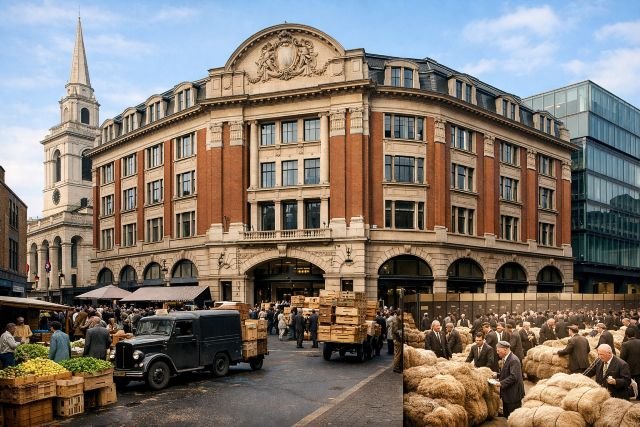
The London Fruit and Wool Exchange was a cornerstone of Britain’s commercial infrastructure during a period when London stood at the center of global trade. As international commerce expanded rapidly, the need for organized, transparent, and regulated trading spaces became essential. The london fruit and wool exchange emerged to meet this need, offering merchants and brokers a centralized marketplace for two of the era’s most important commodities.
Within its first century of operation, the london fruit and wool exchange helped shift trade away from informal negotiations toward standardized, contract-based transactions. This transformation strengthened trust, reduced disputes, and influenced how commodities were traded worldwide. Even though the exchange no longer operates today, its systems and principles continue to shape modern commodity markets.
What Was the London Fruit and Wool Exchange?
The London Fruit and Wool Exchange was a formal commodities market created to regulate and centralize the trade of fruit and wool in London. At a time when trade volumes were growing rapidly, the exchange offered structure to what had previously been fragmented and inconsistent market practices.
Unlike open street markets or private negotiations, the london fruit and wool exchange provided a controlled environment where pricing, quality standards, and contracts were clearly defined. This made it easier for both domestic and international traders to conduct business with confidence.
Historical Background of the London Fruit and Wool Exchange
Origins in an Expanding Empire
The exchange developed during the 19th century, alongside Britain’s Industrial Revolution and the expansion of the British Empire. Wool imports from Australia, New Zealand, and South Africa surged, while fruit arrived in large quantities from the Caribbean and Mediterranean. Managing this volume required an institution capable of handling inspection, pricing, and settlement efficiently.
The london fruit and wool exchange was established as a response to these economic pressures, providing a dedicated space for structured commodity trading.
Why Fruit and Wool Shared One Exchange
Although fruit and wool differ significantly, they shared logistical and commercial challenges. Both relied heavily on maritime transport, required careful quality assessment, and experienced price fluctuations driven by seasonal and global demand factors. Housing these commodities within the same exchange reduced administrative complexity and improved coordination.
Purpose and Core Functions of the Exchange
The primary purpose of the London Fruit and Wool Exchange was to create a centralized trading environment that promoted fairness and transparency. By bringing buyers and sellers together in one regulated space, the exchange reduced price discrepancies and market manipulation.
Another critical function was quality control. Wool, in particular, was graded according to standardized criteria, ensuring consistency across international markets. Fruit traders also benefited from inspection processes that reduced spoilage disputes and improved buyer confidence.
The exchange also played a vital role in price discovery. Open negotiation within a regulated environment allowed prices to reflect real supply and demand, creating reliable benchmarks used far beyond London.
Economic Importance of the London Fruit and Wool Exchange
Contribution to London’s Global Dominance
The london fruit and wool exchange reinforced London’s position as the world’s leading trading and financial center. Alongside institutions such as the London Metal Exchange and the Baltic Exchange, it formed part of a powerful ecosystem that supported Britain’s economic expansion.
Historical records from the Bank of England indicate that commodity trading was a major driver of London’s commercial influence during the 19th century, with exchanges like this playing a central role.
Impact on International Trade Networks
Producers across the British Empire depended on London prices as global reference points. Wool growers in Australia and New Zealand, for example, often priced their exports based on valuations established at the london fruit and wool exchange. This interconnected system helped standardize global trade long before digital markets existed.
How the London Fruit and Wool Exchange Operated
Trading at the exchange followed a structured process designed to minimize risk and disputes. Commodities were first inspected and graded according to agreed standards. Brokers then listed available lots, facilitating negotiations between buyers and sellers. Once terms were agreed, contracts were formalized and settlements arranged.
Brokers played a crucial role in maintaining order and compliance. Their presence ensured that transactions followed exchange rules, protecting both parties and reinforcing trust in the system.
Decline of the London Fruit and Wool Exchange
By the mid-20th century, the relevance of the London Fruit and Wool Exchange began to decline. Advances in transportation, communication, and logistics allowed producers and buyers to negotiate directly. At the same time, specialized exchanges and financial instruments emerged, offering greater efficiency.
The shift toward digital trading platforms further reduced the need for physical trading halls. Gradually, the exchange’s functions were absorbed into broader commodity and financial markets.
The Lasting Legacy of the London Fruit and Wool Exchange
Influence on Modern Commodity Markets
Despite its closure, the london fruit and wool exchange left a lasting mark on global trade. Many practices now considered standard, such as contract standardization, quality grading, and arbitration mechanisms, were refined within its walls.
Modern commodity exchanges still rely on these principles to ensure market stability and transparency.
Cultural and Architectural Significance
The exchange building itself became a symbol of London’s mercantile heritage. While many former exchange spaces have been repurposed, they remain important reminders of the city’s trading past and economic evolution.
Comparison With Other Historic London Exchanges
The London Fruit and Wool Exchange focused primarily on agricultural and textile commodities, while institutions like the London Metal Exchange specialized in metals and the Baltic Exchange concentrated on shipping and freight. Together, these exchanges formed a comprehensive framework that supported Britain’s dominance in global trade.
Frequently Asked Questions About the London Fruit and Wool Exchange
What was the main purpose of the London Fruit and Wool Exchange?
Its main purpose was to centralize and regulate the trade of fruit and wool, ensuring transparent pricing, quality control, and standardized contracts.
Why is the London Fruit and Wool Exchange historically important?
It played a key role in establishing London as a global trade hub and influenced the structure of modern commodity exchanges.
Does the London Fruit and Wool Exchange still operate today?
No, the exchange no longer operates, but its systems and principles continue to influence global markets.
Lessons for Modern Traders and Businesses
The history of the london fruit and wool exchange offers valuable lessons for today’s markets. Standardization builds trust, transparency improves efficiency, and regulation reduces long-term risk. These principles remain just as relevant in digital and globalized trading environments.
Conclusion
The London Fruit and Wool Exchange was more than a physical marketplace; it was a foundational institution that helped shape global commodity trading. By introducing structure, transparency, and consistency, it supported economic growth in Britain and beyond.
Although the exchange itself belongs to history, the influence of the london fruit and wool exchange endures in modern financial systems. Understanding its history provides essential insight into how today’s global markets evolved and why regulated trade institutions continue to matter.