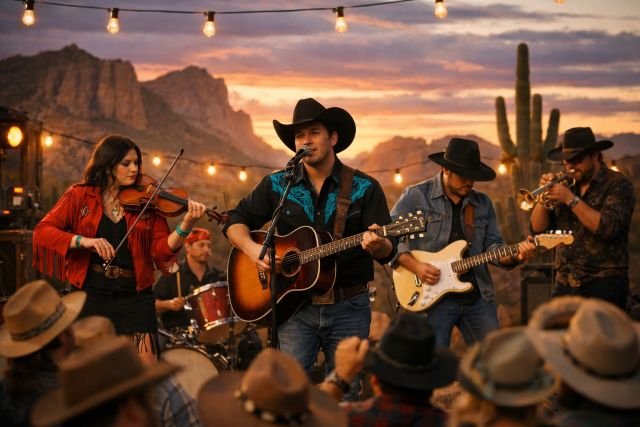
A southwestern band doesn’t usually feel like the “next global phenomenon” on paper. Yet right now, that’s exactly what’s happening across playlists, short-form video, and sold-out venues. The modern music machine rewards more than flawless vocals — it rewards identity, momentum, and community. And the Southwest has all three in abundance: borderland stories, bilingual culture, dance-floor rhythms, and a DIY ethos that translates perfectly to the internet.
This isn’t just hype, either. The bigger industry context is built for breakout acts with a distinct sound and direct-to-fan energy. Streaming is still the dominant revenue engine worldwide, accounting for 69% of global recorded music revenue, with paid subscription users reaching hundreds of millions. In the U.S., recorded-music revenue hit a record $14.9B in 2024, and streaming made up the vast majority of that market. When the system is this digital, a band that knows how to win online can scale fast.
What’s special about a “southwestern sound” today is that it’s not one sound at all. It’s a mashup — regional Mexican, cumbia, norteño/tejano, desert rock, country twang, hip-hop cadence, and pop hooks — delivered with a visual identity that looks instantly recognizable on TikTok, Reels, and YouTube Shorts.
What “southwestern band” means in 2026
In today’s music conversation, “southwestern band” often points to artists rooted in (or influenced by) the U.S. Southwest — Texas, Arizona, New Mexico, Southern California — where cross-border culture shapes everyday life. That can mean bilingual songwriting, accordion-forward arrangements, cumbia percussion, corridos storytelling, or simply an aesthetic that feels like heat, chrome, denim, and neon.
You can see this movement in real-world success stories. For example, Fuerza Regida is an American regional Mexican band formed in San Bernardino, California, and they’re widely associated with the modern corridos wave. Grupo Frontera, another U.S.-based regional Mexican band, is from Edinburg, Texas, and has broken through with a mainstream-ready blend of norteño and cumbia influences. These are concrete proof points that “Southwest-origin” is no longer a niche label — it’s a launchpad.
Why the timing is perfect: the industry now rewards regional-to-global
For years, the industry’s default strategy was “get on radio, then tour.” Now it’s closer to “win attention, then convert it into superfans.”
A few signals make this moment unusually favorable:
Streaming scale is enormous. Luminate reported 5.1 trillion global music streams in 2025, up year over year, with the U.S. alone accounting for 1.4 trillion streams. That volume creates space for scenes to grow without asking anyone’s permission.
Streaming revenue keeps rising. IFPI reports global recorded music revenues grew again in 2024, and streaming remained the biggest format globally. In the U.S., streaming revenue continues to dominate overall recorded-music revenue.
Latin and regional sounds keep moving mainstream. In the U.S., Latin music revenues have reached new highs, and reporting tied to Luminate/RIAA has highlighted Regional Mexican as a growth driver within that ecosystem. That tailwind benefits a southwestern band even if they’re genre-hybrid rather than “pure” traditional.
The real reasons a Southwestern band breaks out
Let’s get practical. Here are the forces that typically explain why one act rises while others with similar talent stay local.
1) They blend genres without losing identity
The bands “taking the music world by storm” don’t sound like a committee designed them. They sound like a neighborhood, a car stereo, a family party, and a late-night drive — at the same time.
The Southwest is uniquely positioned for this because genre-blending is already normal there. A hook might land like pop, the rhythm might swing like cumbia, the storytelling might carry corrido DNA, and the drum textures might nod to hip-hop. That combination travels well because it gives different listeners different entry points.
Actionable tip: if you’re building a similar sound, keep one “signature ingredient” consistent across tracks (for example: a specific accordion tone, a recurring percussion pattern, or a vocal cadence). Consistency is what turns “interesting” into “recognizable.”
2) They win short-form video with moments, not marketing
Most bands try to go viral by posting “content.” Breakout bands post moments.
A moment has three parts: a recognizable look, a repeatable audio snippet, and a simple emotional trigger. It could be a one-line chorus that hits hard, a danceable drop, a crowd sing-along, or even a funny backstage phrase that becomes a tag.
The key is that short-form doesn’t need a whole song. It needs 7–15 seconds that people want to replay—and reuse.
Actionable tip: build every single around two “clip points”: one lyric-first moment (caption-friendly) and one rhythm-first moment (dance/remix-friendly). You’re not selling a track; you’re selling shareable fragments that lead back to the full track.
3) They understand streaming economics — and build multiple income lanes
Streaming has expanded opportunity, but it can’t be the only plan. Spotify’s own reporting emphasizes how many artists cross meaningful royalty thresholds, and how large the independent share has become on-platform. Major platforms also publicly highlight large total royalty payouts, showing how much money flows through streaming — even if the split varies by deal structure.
4) They tour smarter: hometown gravity, then outward expansion
A classic mistake is trying to “go national” too early. The bands that surge tend to do this instead:
They dominate a tight radius (their city/region)
They create a repeatable live experience (chants, call-and-response, a standout intro)
They capture that experience on video (not polished — real)
Then they expand one “connected” market at a time (places with diaspora ties, college scenes, or algorithmic listener clusters)
This strategy matches how fans actually move. People don’t adopt a new band because they saw an ad. They adopt a new band because a friend sent a clip, then the next time the band comes to town, it feels like an event.
5) They carry a story people want to join
A southwestern band often has narrative advantages baked in: migration stories, bilingual households, border-town weekends, desert romance, working-class hustle, and pride in place.
That’s not “branding.” That’s belonging.
When fans feel like listening is a way of signaling identity — “this is my culture,” “this is my town,” “this is my kind of night” — growth compounds.
A mini case study: the “desert-to-global” breakout pattern
Imagine a 5-piece southwestern band starting in a mid-sized city. They play quinceañeras, local bars, and community festivals. Their early tracks are solid but not explosive.
Then they do three things differently:
First, they write a chorus designed to be captioned. The lyric is simple, bilingual, and emotionally direct. It becomes the quote people use under relationship posts.
Second, they record live performance clips where the crowd is loud enough to feel through the phone. The internet doesn’t just hear the song — it hears proof that the song works.
Third, they release a remix featuring a neighboring-scene artist — someone adjacent in genre but big in short-form. Suddenly, the band’s sound moves into new algorithm neighborhoods.
This is how “overnight success” actually happens: small compounding moves, executed consistently, in an ecosystem built for fast discovery.
Why a Southwestern band connects across cultures
A southwestern band often wins globally because the music is culturally specific but emotionally universal. The best hooks aren’t “about the Southwest.” They’re about love, pride, regret, confidence, and freedom — just told with fresh vocabulary, rhythms, and visuals.
That combination is powerful in 2026 because listeners are increasingly comfortable crossing language boundaries. Global streaming volume is massive, and genre borders are more porous than ever.
FAQs
What makes a southwestern band different from other bands?
A southwestern band typically blends borderland influences—like regional Mexican, cumbia, tejano, country, rock, and hip-hop—often with bilingual lyrics and a strong sense of place.
Why are southwestern bands going viral right now?
Because streaming and short-form video reward distinctive identity and repeatable moments. With global streaming at trillions of plays annually, regional scenes can scale faster than ever.
Is the rise of Regional Mexican and Latin music part of this trend?
Often, yes. U.S. market reporting has pointed to Regional Mexican as a driver inside Latin music growth, creating tailwinds for Southwest-adjacent acts and collaborators.
How can a new southwestern band grow faster?
Focus on two clip-worthy moments per release, capture high-energy live footage, collaborate with adjacent-scene artists, and build a repeatable hometown show before expanding outward.
Conclusion: the Southwestern wave is a blueprint, not a fluke
A southwestern band taking the music world by storm isn’t a mystery — it’s a signal that music has finally caught up with culture. The Southwest has always been a collision point for sounds and stories. Now the internet makes that collision scalable.
With streaming dominating revenue and global listening reaching record highs, the bands that combine a clear identity, smart short-form moments, and community-first touring can grow explosively. If you’re an artist, manager, or label watching this wave, the takeaway is simple: don’t sand down what makes the music regional. Amplify it, package it for modern discovery, and let the world come to you.