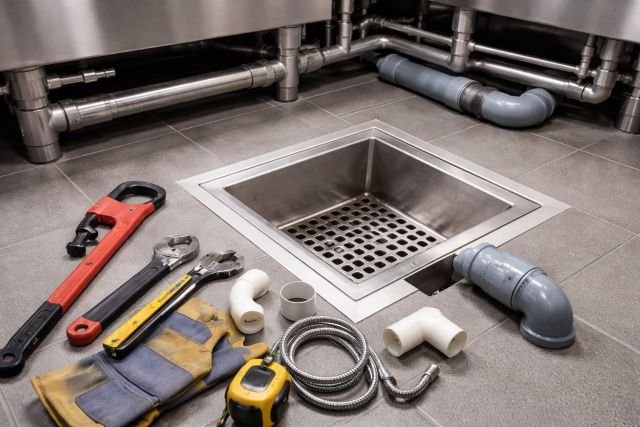
If you’ve ever looked behind a commercial ice machine, dishwasher, or prep sink and noticed a small, box-like drain set into the floor, you were probably looking at a floor sink. A floor sink isn’t just “another drain.” It’s often the code-friendly way to handle indirect waste while protecting potable water from contamination risks like backflow.
In this guide, you’ll learn exactly what a floor sink is, when you need one, how it differs from a floor drain, the real benefits in restaurants and commercial buildings, and the biggest mistakes that cause odors, inspections failures, and surprise repair bills.
What is a floor sink?
A floor sink is a plumbing fixture installed at floor level that acts as an indirect waste receptor—meaning it receives wastewater from equipment or fixtures that must not connect directly to the sanitary system. Instead, the equipment’s drain line discharges into the floor sink through a physical air gap (an open vertical separation), which helps prevent contamination from backflow.
Think of it like a controlled “catch basin” for wastewater from food-service and mechanical equipment — especially where codes require an air gap.
Floor sink vs. floor drain: what’s the difference?
People mix these up all the time, and that confusion leads to bad installations.
Floor drain: Primarily intended to remove water from the floor (mopping, spills, washdown).
Floor sink: Primarily intended to receive indirect discharge from equipment (ice makers, dishwashers, prep sinks, condensate lines) while maintaining a compliant air gap.
Here’s the practical takeaway:
If you’re dealing with food equipment or anything that could create a cross-connection risk, a floor sink is often the safer (and more inspectable) choice.
Why floor sinks matter in commercial kitchens and food facilities
In food environments, plumbing isn’t just about drainage — it’s about public health. Many codes and food-safety programs emphasize avoiding cross-connections and ensuring proper backflow protection.
The International Plumbing Code (IPC) explicitly calls out food-handling equipment and fixtures: they must discharge through an indirect waste pipe by means of an air gap into a waste receptor. A floor sink is a common receptor used for that purpose.
Common uses of a floor sink
A floor sink shows up anywhere you need a clean, code-compliant “landing zone” for indirect waste. Typical examples include:
Restaurants and commercial kitchens
- Ice machines and ice bins (ice is treated like food/potable water in many inspections, so air gaps matter)
- Commercial dishwashers
- Prep sinks with indirect waste requirements
- Beverage equipment and drip trays
These scenarios commonly require an air gap into a waste receptor such as a floor sink.
Mechanical rooms and building systems
- HVAC condensate lines (common in larger buildings)
- Relief lines and equipment drains that should not be hard-piped into sanitary without proper protection (requirements vary by jurisdiction)
Healthcare and lab-like environments (jurisdiction-dependent)
Some equipment discharges are treated as “special waste” or require indirect connections. IPC Chapter 8 covers indirect/special waste concepts broadly, and local amendments often get specific.
Benefits of installing a floor sink
1) Helps meet air-gap and indirect waste requirements
The air gap is the headline benefit. Many regulations and guidance documents define air gap requirements (often described as a vertical separation, commonly “twice the pipe diameter” and not less than 1 inch—details vary by code/food rule).
2) Reduces cross-connection and backflow risk
Indirect waste and proper air gaps are fundamental backflow prevention strategies in food facilities.
3) Cleaner, more inspectable installs
Inspectors like obvious, visible separations. A properly installed floor sink makes it easy to verify compliance—especially compared with questionable “creative plumbing” that hides connections in walls or cabinets.
4) Contains mess and protects floors
When equipment dumps water, a floor sink helps control splashing and directs flow into a designated receptor instead of across the floor.
5) Simplifies equipment swaps
When you replace an ice machine or dishwasher, you can often reuse the receptor location (assuming sizing and placement were done well), which saves time.
How a floor sink should be installed (high-level, code-aware guidance)
Because local plumbing codes vary, your plumber should confirm requirements with the Authority Having Jurisdiction (AHJ). But conceptually, good floor sink installations tend to share a few traits:
Maintain a true air gap (not an “air break” when air gap is required)
Guidance documents distinguish between an air gap and an air break. An air gap is a true vertical separation above the flood level rim; an air break may terminate below the flood level rim and is not always permitted — especially for food prep discharges.
If your setup is for food-handling equipment, assume you need an air gap unless your AHJ clearly allows otherwise.
Put the floor sink where water actually goes
A perfect air gap doesn’t matter if the receptor is too far away and staff “temporarily” run a hose across a walkway. In the real world, the correct location is:
- close to the equipment,
- out of traffic paths,
- accessible for cleaning,
- and placed so discharge doesn’t splash out.
Plan for cleaning access
Floor sinks collect biofilm and debris over time. If you can’t reach it, it won’t get cleaned — and then you get odors, slow drains, and fruit flies.
Common floor sink mistakes to avoid (the ones that fail inspections)
Below are the failure points that show up again and again in restaurants, cafés, and production kitchens.
Mistake 1: Hard-connecting the equipment drain into the receptor
When someone “tidies up” and converts an indirect setup into a direct connection, you can lose the protective separation that prevents backflow contamination. That’s the opposite of what codes aim for with indirect waste.
Real-world scenario:
An ice machine line is directly tied into a hub drain below the rim. The line is now vulnerable if the drainage system backs up. Even if it “worked fine for years,” it may not be compliant.
Mistake 2: Using an air break when an air gap is required
Some setups look “separated” but terminate below the flood level rim — often categorized as an air break. Food-related discharges frequently require a true air gap.
Mistake 3: Undersizing the floor sink (it can’t keep up)
If the receptor can’t handle peak discharge, you get overflow onto the floor — usually right when the kitchen is slammed. Sizing is about flow rate, not just pipe diameter.
Mistake 4: Poor trap and vent considerations (odor city)
Odors are one of the top complaints. Common causes include:
- trap seal loss (dry trap),
- improper venting in some layouts,
- slow drainage that leaves residue behind.
(Your plumber should handle the technical details per code, but as an owner/operator, you want to spot risk signs early: recurring sewer smell, gurgling, slow drain.)
Mistake 5: Placing the sink where staff can’t clean it
If the floor sink is under a fixed piece of equipment with no clearance, it becomes a hidden sludge box.
Mistake 6: Letting “miscellaneous” drains dump into it
A floor sink is not a universal dumping ground. Condensate slime, mop water, beverage waste, and other discharges can create buildup and odor issues, and some combinations are specifically discouraged in guidance for food facilities.
Floor sink maintenance tips that actually prevent problems
You don’t need fancy routines — just consistent ones.
- Clean on a schedule: light cleaning frequently beats “deep cleaning” once things smell.
- Watch for biofilm sources: refrigeration condensate and some beverage lines create fast buildup (the “nasty slime” problem shows up in guidance).
- Keep water in the trap: if the area is rarely used, traps can dry out and let sewer gas in.
- Train staff not to modify drains: the most expensive issues often start as “we just moved this hose real quick.”
Choosing the right floor sink: what to consider
Even before brand/model decisions, focus on functional fit:
- Application type: food equipment vs. general equipment waste
- Expected discharge volume: steady drips vs. periodic dumps
- Space and accessibility: can you clean it weekly without moving heavy equipment?
- Material and environment: corrosion resistance matters in harsh washdown areas
- Local code and inspection style: some AHJs are very strict about air-gap geometry and visibility
FAQs
Do you need a floor sink for an ice machine?
Often, yes — especially in commercial food settings. Ice is treated like food/potable water in many inspections, so the drain setup commonly needs an air gap discharging into a waste receptor such as a floor sink.
What’s the difference between an air gap and an air break?
An air gap is an unobstructed vertical separation between the end of a pipe and the flood level rim of the receptor. An air break is an indirect connection where the pipe may terminate below the flood rim and is not always allowed — especially for food prep discharges.
Can a floor drain be used instead of a floor sink?
Sometimes, but it depends on the receptor design, code interpretation, and whether the setup maintains a compliant air gap and is approved by the AHJ. Many guidance documents explicitly show a floor sink used as the waste receptor for indirect drains in kitchens.
Why does my floor sink smell like sewage?
Common causes include a dry trap (trap seal evaporation), buildup/biofilm, or drainage issues. Regular cleaning and keeping water in the trap often reduces odors, but persistent smells should be evaluated by a plumber to rule out venting or drainage problems.
What is an “indirect waste receptor”?
An indirect waste receptor is a receptor that receives discharge from a waste pipe that is not directly connected and maintains a suitable air gap between the pipe end and the receptor.
Conclusion: when a floor sink is the right call
A floor sink is one of those unglamorous fixtures that quietly protects your operation: it supports indirect waste discharge, makes air gaps easier to inspect, helps reduce cross-connection risk, and keeps commercial kitchens and mechanical spaces cleaner and safer. In practice, most headaches come from predictable errors — missing air gaps, direct connections, poor placement, and neglected cleaning. Align the installation with your local code and inspection expectations, keep it accessible, and treat it like a critical health-and-safety component — not just “a drain in the floor.”