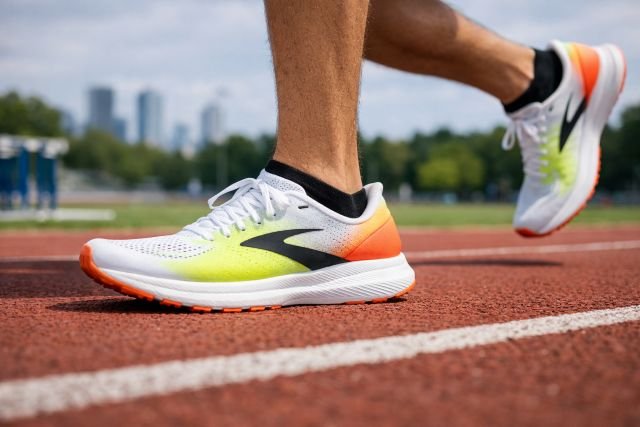
If you’re hunting for a lightweight speed trainer that feels more “fast flat” than “max-cush cruiser,” the brooks hyperion tempo has earned its reputation for a reason. Even in today’s era of tall, rockered, plated trainers, the Hyperion Tempo keeps things simple: low-ish stack, quick transitions, and a ride that encourages you to pick up the pace without feeling like you’re running on stilts. It’s also notably light for a daily-capable trainer, which is a big part of why runners keep coming back to it.
This performance test breaks down what matters most — speed, fit, and real-run feel — so you can decide whether this shoe belongs in your rotation (or whether a newer “super trainer” would suit you better).
Brooks Hyperion Tempo at a glance
The Hyperion Tempo launched as a training partner to Brooks’ Hyperion Elite racer, aiming to deliver fast-day mechanics without a carbon plate. It uses DNA FLASH cushioning — Brooks’ nitrogen-infused foam approach designed to be lightweight and responsive.
One important note for shoppers: in some regions, Brooks lists the Hyperion Tempo as discontinued and replaced by the “Hyperion.” That doesn’t make the Tempo irrelevant — if anything, it can be a great value when you find it on discount — but it does change availability.
Quick specs (common references)
Specs can vary slightly by source and whether measurements include the sockliner, but the commonly cited numbers are:
| Spec | Typical value |
|---|---|
| Weight | ~204 g / 7.2 oz (men’s US 9) |
| Stack height | ~26 mm heel / 18 mm forefoot |
| Drop | 8 mm |
| Category | Neutral, lightweight performance trainer |
Performance test: what “fast” actually feels like in the Hyperion Tempo
When people say the brooks hyperion tempo is “fast,” they usually mean two things:
- it’s light enough that you notice it immediately, and
- the ride is direct, so your stride feels snappy and controlled rather than bouncy and marshmallow-soft.
RunRepeat’s lab-style testing and commentary highlights that lightweight, lower-stacked “old-school fast” feel, even if some runners want more energy return.
Speed sessions: intervals, reps, and track-adjacent work
On interval days (think 400s to 1Ks, or short hill repeats), the Hyperion Tempo’s strength is how quickly it gets out of your way. The shoe doesn’t over-correct your form with a huge rocker or a rigid plate. Instead, it rewards clean mechanics: quick cadence, stable footstrike, and strong toe-off.
A lot of modern “super trainers” feel like they’re doing some of the work for you — great when you’re tired, less great when you want to feel the ground and nail pacing. The Hyperion Tempo leans the other direction: it’s responsive, but it still feels like you are the engine.
Who benefits most here: runners who like a traditional speed-trainer feel and want a shoe that stays predictable when you surge, corner, or hit uneven pavement.
Tempo runs: the shoe’s “sweet spot”
The name isn’t accidental: sustained “comfortably hard” running is where the Tempo shines.
The DNA FLASH midsole is designed with nitrogen infusion to dial in a lighter, more energetic foam compound (Brooks’ own explanation emphasizes improved energy return while staying lightweight). In practice, many runners describe the ride as firm-to-moderate rather than plush — more “ready to work” than “sink in and relax.”
If your tempo pace is the kind of effort where you’re working but not grinding, the Hyperion Tempo can feel like a metronome: steady, efficient, and easy to trust.
Long runs: surprisingly capable, with caveats
Can you long-run in it? Yes — especially if you’re a lighter runner, you like firmer shoes, or your long runs include progression segments. But if your long-run priority is cushioning first, you may prefer a higher-stack option.
This matters because stack height can influence stability and running style in ways we’re still learning about. A 2025 study comparing different stack heights (low/medium/high) suggests stack height can affect running style and stability metrics during treadmill running. The Hyperion Tempo’s more moderate stack can feel naturally stable compared with towering foams — one reason it stays controlled when you’re fatigued.
Best long-run use case: long runs with quality (marathon-pace blocks, fast finishes), when you want a lighter shoe that still has enough protection for the distance.
Fit and upper: locked-in speed without racing-shoe punishment
Fit is where the Hyperion Tempo quietly wins people over. It tends to feel “performance snug” without being brutally narrow—more training-friendly than many pure racers.
Forefoot and midfoot: secure, not sloppy
For faster running, you want the upper to disappear — no hot spots, no lace bite, no midfoot slide. Many reviews describe the upper as breathable and smooth-fitting.
If you usually size true-to-size in Brooks, most runners stick with that. If you’re between sizes or prefer extra toe splay, going up half a size can be a safe move — especially for long runs where feet swell.
Heel hold and stability
Heel security is crucial at speed, and the Tempo generally does well here. The shoe’s geometry and more moderate stack can also help it feel planted compared with very tall, soft foams.
If you’re coming from maximal “superfoam” trainers, the Hyperion Tempo may initially feel firmer — but many runners adapt quickly and end up enjoying the control.
Real-run results: three scenarios most runners actually do
Here’s how the brooks hyperion tempo typically plays out in real training — not lab fantasy, but workouts you’d put on a plan.
Scenario 1: 6 × 800m at 5K pace (with jog recoveries)
You want a shoe that transitions fast and stays consistent across reps. The Tempo’s low-weight build helps you keep turnover high late in the workout. Because it’s not overly rockered, you can run the curves and recoveries without feeling unstable or “tippy.”
What you’ll notice: quicker cadence feels easier to maintain; landings feel firmer and more precise than plush trainers.
Scenario 2: 20–40 minute steady tempo run
This is where it clicks. The shoe feels efficient and straightforward: it doesn’t beg you to sprint, but it supports sustained pace without feeling mushy.
What you’ll notice: “set it and forget it” rhythm, especially if your form is compact and you don’t overstride.
Scenario 3: Long run with a fast finish (last 20 minutes at marathon pace)
The shoe’s biggest long-run advantage is how it changes your mechanics when you accelerate late. Some high-stack trainers feel great slow but awkward fast; the Hyperion Tempo is the opposite.
What you’ll notice: it’s easier to shift gears without feeling like you’re fighting the midsole.
Cushioning and tech: what DNA FLASH means (and what it doesn’t)
Brooks describes nitrogen infusion as a way to tune foam energy return while also reducing weight, first used in DNA FLASH for the Hyperion Tempo. This concept — using a supercritical process to create a lighter, more resilient foam—shows up across the industry.
Two important reality checks:
- Nitrogen-infused doesn’t automatically mean “bouncy like PEBA.” Some runners feel the Tempo is more “responsive-firm” than “trampoline.”
- Plates + superfoams have the strongest research base for measurable economy gains. Research on “super shoes” suggests meaningful running economy improvements in certain plated models (often cited in the ~2.7–4.2% range for Vaporfly-era footwear), though the mechanisms are complex.
So, think of the Hyperion Tempo as: fast because it’s light and efficient, not because it’s a modern “super shoe” that radically changes economy.
Durability and outsole grip: how it holds up
Lightweight shoes sometimes die young. The Hyperion Tempo’s reputation is that it’s relatively durable for its class, with strategic rubber placement and a straightforward build.
If you’re using it mainly for 1–2 quality sessions per week, it can last well. If it becomes your do-everything daily trainer, lifespan depends heavily on your weight, stride, and surfaces.
Who should buy the Brooks Hyperion Tempo
It’s a strong pick if you want…
- a lightweight trainer for tempo runs and speedwork that still feels training-friendly
- a shoe that feels stable at faster paces without a plate
- a “classic fast trainer” ride in a world of very tall shoes
You might skip it if you prefer…
- very soft, high-stack cruising comfort
- a plated, PEBA-based “super trainer” sensation (more bounce, more rocker)
- maximum long-run protection above all else
Brooks Hyperion Tempo vs newer options
Because the Tempo has been phased out in some regions and replaced by the Hyperion, it’s worth deciding what you’re truly after: the Tempo’s direct feel, or a more modern, higher-stack experience.
A simple way to choose:
- If you want lower stack + ground feel + speed-day precision, the Tempo is the vibe.
- If you want more cushion for longer efforts while staying quick, newer models in the market may suit you better (including within Brooks’ current Hyperion family).
FAQ: featured-snippet friendly answers
Is the Brooks Hyperion Tempo good for daily training?
Yes—if you like a firmer, lighter daily trainer and you’re not chasing maximum cushioning. Many runners use it as a do-it-all option, but it’s at its best when your week includes faster running.
Is the Brooks Hyperion Tempo a racing shoe?
It can be used for races (especially 5K to half marathon for runners who prefer non-plated shoes), but it was positioned more as a fast trainer companion to the Hyperion Elite racing line.
How does the Hyperion Tempo fit compared to other Brooks shoes?
Most runners go true-to-size with a performance-style fit: secure enough for speed, not as extreme as a racing flat. If you want extra toe room for long runs, consider a half size up.
Is the Brooks Hyperion Tempo discontinued?
In some regions, yes — Brooks has listed it as discontinued and replaced by the “Hyperion.” Availability varies depending on your country and retailer.
What is DNA FLASH cushioning?
DNA FLASH is Brooks’ nitrogen-infused foam approach first used in the Hyperion Tempo, intended to create a lightweight ride with tuned energy return.
Conclusion: should you buy the Brooks Hyperion Tempo?
If you want a shoe that makes faster training feel clean, controlled, and efficient — without relying on a carbon plate or towering stack—the brooks hyperion tempo is still one of the most compelling lightweight performance trainers of its era. It’s quick because it’s light, stable because it avoids extremes, and effective because it keeps your mechanics honest.
The biggest decision today is availability: with the model discontinued in some regions and replaced by the Hyperion, the Hyperion Tempo often shows up as a discounted “hidden gem.” If you find your size, and your training includes tempos, intervals, and progression long runs, it’s a smart buy — especially for runners who prefer a more traditional, fast-trainer ride over modern super-shoe softness.