If you’ve ever bought a “standard” pillowcase and wondered why your pillow swims inside it, you’re in good company. Shopping for common pillow sizes sounds simple until you realize brands and countries label “standard” differently, and your sleep position changes what feels supportive. The good news is that once you understand the main dimensions and how they interact with loft and firmness, choosing becomes easy and you stop wasting money on the wrong fit.
This guide breaks down the most common pillow dimensions, explains which sizes work best for side, back, and stomach sleepers, and helps you match pillows to your bed and pillowcases. You’ll also see research-backed sleep-position insights and practical, real-world scenarios so you can choose confidently.
What “common pillow sizes” means in real life
When people say “common pillow sizes,” they typically mean the everyday sleeping pillow sizes you’ll see most often in bedding aisles and online catalogs. In the U.S., the most common are Standard, Queen, and King. In the UK and parts of Europe, you’ll often see pillows sold in centimeters with popular formats such as 50×80 cm, plus square Euro-style pillows used for layering. Dimensions can vary slightly by brand, but the baseline sizing is consistent enough to plan bedding around it. For example, many retailers list a standard pillow around 20×26 inches and a king around 20×36 inches.
Choosing the “right” size isn’t only about what fits your bed aesthetically. It also affects how stable the pillow feels under your head, whether it stays in place when you move, and how easy it is to find pillowcases that fit without bunching or sliding.
Common pillow sizes and their typical dimensions
Standard pillow size
A standard pillow is the most widely used option in the U.S. and is often bundled with basic sheet sets. Many size charts list it at about 20×26 inches. It’s easy to shop for, works well in guest rooms, and fits smaller beds without taking over the mattress.
Standard size is also a practical choice if you prefer a “contained” feel. Some sleepers don’t like a lot of extra pillow surface because it encourages scrunching the pillow, which can change neck support over the course of the night.
Super standard pillow size
A super standard pillow is a slightly longer version of standard, commonly shown around 20×28 inches on sizing charts. It’s not as universal as standard or queen, but it can feel like a small upgrade if you want a bit more room for shifting your head without moving your whole pillow.
If you’ve ever felt like standard is almost right but you “run out of pillow” when you roll slightly, super standard can solve that without changing your bedding setup too much.
Queen pillow size
A queen pillow is often described as a happy middle ground. Many retailers list queen pillows around 20×30 inches. That extra length can feel noticeably better for people who move around or sleep closer to the edge of the pillow.
Queen is also popular because it scales well on both full and queen beds, giving you a fuller look without the bulk of king pillows.
King pillow size
King pillows are long and generous, commonly listed around 20×36 inches. They’re great if you want maximum surface area, you toss and turn, or you like propping your arm under the pillow.
King can feel too large on smaller mattresses, though. On a twin or full bed, it can dominate the width and make the sleeping space feel cramped.
Body pillow size
Body pillows are designed to hug, drape, or place between the knees. Size charts commonly list body pillows around 20×54 inches. They’re especially useful for side sleepers who want extra hip and spine alignment support, because a supported top leg can reduce twisting through the lower back and shoulders.
In practice, a body pillow can indirectly improve neck comfort by improving overall alignment. When your spine is straighter, your head pillow doesn’t have to “fight” the rest of your posture.
Euro pillow size
Euro pillows are typically square and more often used for decorative layering or sitting up in bed, though some people do sleep on them. Common charts list Euro pillows at 26×26 inches.
If you’re tempted to sleep on a Euro pillow, make sure you love a large, square surface and that you can find properly fitting covers. Many sleepers find Euro pillows better as a support cushion behind their main sleeping pillow rather than as the primary pillow.
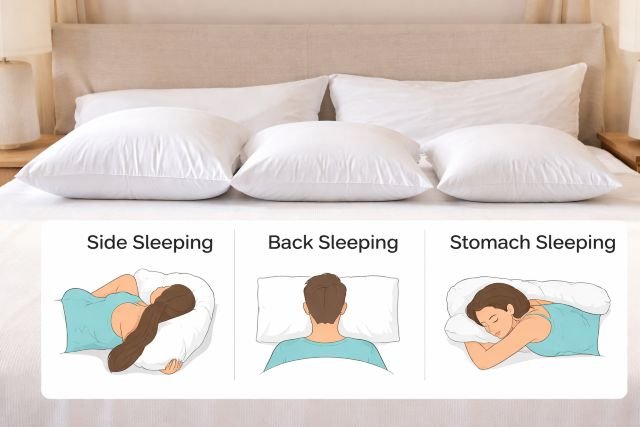
How to choose common pillow sizes by sleeping position
Here’s the key: pillow size affects surface area and stability, but loft and firmness determine whether your neck stays aligned. Think of size as the “platform” and loft as the “support height.”
Research measuring people sleeping at home has found that side sleeping often dominates the night, with back sleeping next, and front/stomach sleeping least common. In one study, time in bed was about 54.1% side, 37.5% back, and 7.3% front. That matters because your best pillow choice should support the position you spend the most time in, even if you occasionally switch.
Side sleepers
Side sleeping usually creates the largest gap between your head and the mattress because your shoulder raises your torso. That’s why side sleepers often do best when the pillow has enough loft to fill that gap and keep the neck from bending downward.
Guidance on loft by sleep position often points to medium-to-high loft for side sleepers. In terms of common pillow sizes, queen and king pillows can feel more stable for side sleepers, especially for people who roll from one side to the other and want to stay centered on the pillow.
A real-world example helps. Imagine you’re a side sleeper on a queen bed, and you shift from left to right a few times a night. With a standard pillow, you may end up repositioning it after each roll. With a queen pillow, you often have enough length to re-center your head without adjusting the pillow itself. The size doesn’t fix alignment alone, but it can reduce the “maintenance” of staying comfortable.
If you also wake with tight hips or lower back discomfort, pairing your head pillow with a body pillow can be a powerful alignment move. Body pillows are commonly listed around 20×54 inches on size charts.
Back sleepers
Back sleepers typically do best when the pillow supports the natural curve of the neck without pushing the head too far forward. The wrong loft is often the culprit when back sleepers wake with stiffness, especially if the pillow is thick and firm.
Many loft guides suggest medium loft is often a better match for back sleeping than very high loft. In terms of common pillow sizes, standard or queen is usually plenty for back sleepers. The extra length of queen can be helpful if you move your head side to side, but you rarely need king for support reasons alone.
Harvard Health notes that the “best” sleep position can depend on your body and comfort needs, and it also highlights how posture and alignment matter for avoiding strain. This is why back sleepers should treat loft and shape retention as the priority, and size as a secondary preference.
Stomach sleepers
Stomach sleeping often involves turning the head to one side, which can strain the neck. Many experts caution that stomach sleeping can be harder on the neck and back, especially if the pillow is tall.
If you’re a stomach sleeper and you don’t plan to change positions, the biggest comfort win is usually reducing loft. Loft guidance often places stomach sleepers in the low-to-medium range, and some people do best with a very minimal pillow. In common pillow sizes, standard is typically the safest choice because it’s easier to keep low-profile, and you’re less tempted to buy an oversized pillow that ends up being too thick.
A practical scenario: if you’re currently using a plush king pillow and waking with neck stiffness, downsizing to a standard pillow with a lower loft can feel like an immediate improvement. The size change helps because many king pillows are filled and constructed to feel “big,” which can increase height and push the neck into a sharper angle.
Combination sleepers
If you rotate between side and back sleeping, queen is often a reliable compromise because it offers more room than standard without the bulk of king. Another strong option is an adjustable-fill pillow, because you can tune loft to match your most common position. Expert pillow roundups often highlight adjustable fill as useful for dialing in comfort.
Matching pillow size to bed size and room layout
Even if comfort is your main goal, bed size and layout affect whether a pillow feels practical. A pillow that’s too large can crowd a smaller bed and make you feel pushed toward the edge. A pillow that’s too small on a larger bed can look and feel undersized, especially if you sit up in bed often.
In general, standard pillows tend to suit twin and twin XL beds well because they fit the width without overwhelming it. Full beds often work with standard or queen depending on how much pillow presence you want. Queen beds naturally pair well with queen pillows for balanced proportions. King beds can comfortably accommodate king pillows without crowding, especially if you like a “hotel” feel.
If you share a bed, think about pillow drift. Larger pillows can reduce the frequency of repositioning, but only if they don’t push you into awkward spacing. For some couples, two queen pillows can feel more manageable than two kings while still offering room to move.
Pillowcase fit and international sizing
Pillowcase fit is where people get frustrated, especially when shopping online or across regions. If the case is too loose, the pillow slides and bunches. If it’s too tight, it compresses loft and changes how your pillow supports your neck.
International sizing adds another layer. Some retailers in the UK commonly sell pillowcases around 50×80 cm, while many European setups also include square Euro formats. The takeaway is simple: don’t rely on the word “standard.” Always check the numeric dimensions before buying pillowcases or shams.
If you’ve ever felt like your pillow suddenly “doesn’t support you anymore” after changing pillowcases, compression is a real possibility. A tighter cover can flatten a pillow, effectively lowering loft and changing alignment.
Materials and loft: the comfort multipliers
After you choose the right common pillow size, material and loft determine whether the pillow stays supportive over time.
Adjustable-fill pillows can be especially useful for people who aren’t sure whether they need more or less loft, or who change positions during the night. Expert guides often call out adjustable fill as a strong feature for tailoring comfort. Latex tends to be responsive and springy, which many side sleepers like for consistent support. Down and down-alternative can feel plush, but may compress more depending on construction.
Replacement timing matters too. Sleep resources commonly recommend replacing pillows roughly every 1–2 years depending on condition and material, because support and hygiene degrade over time. If your pillow is the right size but suddenly feels wrong, it may not be a sizing problem at all. It may be that the fill has broken down and the loft you used to rely on is gone.
FAQ about common pillow sizes
What are the most common pillow sizes?
The most common sleeping pillow sizes are Standard at about 20×26 inches, Queen at about 20×30 inches, and King at about 20×36 inches, with slight variations by brand.
Is a queen pillow bigger than a standard pillow?
Yes. Queen pillows are typically longer than standard pillows, which gives you more room to shift without repositioning the pillow.
Which pillow size is best for side sleepers?
Many side sleepers prefer queen or king sizes for extra stability, but the biggest factor is usually loft and firmness. Side sleepers often do best with medium-to-high loft to support the shoulder-to-head gap.
Which pillow size is best for stomach sleepers?
Stomach sleepers often do best with a standard-size pillow that stays low profile, because lower loft can reduce neck strain compared with thick pillows.
Do pillow sizes vary by country?
Yes. “Standard” sizes differ by region, and many UK/EU products are listed in centimeters, including common formats like 50×80 cm and square Euro-style options.
Conclusion
Choosing common pillow sizes is easiest when you begin with how you sleep. Side sleepers often appreciate the extra stability of queen or king, paired with the right loft to keep the neck aligned. Back sleepers usually do well with standard or queen, focusing on medium loft and consistent support. Stomach sleepers often feel better with a standard pillow that stays flatter, since excessive loft can worsen neck strain.
Once you confirm dimensions and match pillowcases correctly, you avoid the biggest comfort problems: sliding pillows, compressed loft, and nightly repositioning. For internal linking, you can point readers to related pages such as /pillow-loft-guide, /pillowcase-size-guide, and /best-pillows-for-side-sleepers to build topical depth and help them make a personalized choice.