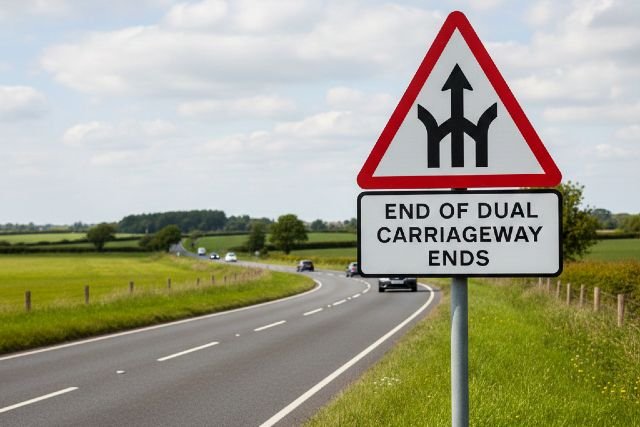
The end of dual carriageway sign plays a critical role in road safety, yet many drivers underestimate its importance. This sign indicates a major change in road layout where a divided road becomes a single carriageway with traffic flowing in both directions. Understanding how to respond correctly can prevent accidents, reduce confusion, and ensure compliance with traffic laws. Whether you are a learner driver or an experienced motorist, recognizing and reacting properly to this sign is essential for safe driving.
In this guide, we explore the meaning of the end of dual carriageway sign, the traffic laws that apply after it, common driver mistakes, and practical safety tips backed by real-world driving scenarios and authoritative sources.
What the End of Dual Carriageway Sign Means
The end of dual carriageway sign warns drivers that the central reservation separating traffic directions is ending. From this point onward, vehicles traveling in opposite directions will share the same road space. This change significantly increases the need for caution, as oncoming traffic is no longer physically separated.
Road authorities place this sign well in advance so drivers have enough time to adjust their speed, positioning, and awareness. Ignoring or misunderstanding the sign often leads to dangerous overtaking attempts and poor lane discipline.
How to Identify the End of Dual Carriageway Sign
The sign is triangular with a red border and a black symbol showing two carriageways merging into one. It is designed to be instantly recognizable, even at higher speeds. You will commonly encounter this sign on rural A-roads, near roadworks, at the approach to towns, or where older highways narrow into standard roads.
Because this sign marks a transition zone, it is often accompanied by changes in road markings and follow-up speed limit signs.
Traffic Laws After the End of Dual Carriageway Sign
Traffic laws change immediately after passing the end of dual carriageway sign, and drivers are legally required to adapt without delay.
On UK roads, the national speed limit for cars usually drops from 70 mph on a dual carriageway to 60 mph on a single carriageway unless posted otherwise. In built-up areas, the limit may reduce further. Drivers who fail to slow down risk fines, penalty points, and increased accident severity.
Overtaking rules also become stricter. On a single carriageway, overtaking must account for oncoming traffic, limited visibility, and road markings. Dangerous overtakes after the end of a dual carriageway are a leading cause of head-on collisions.
Why the End of Dual Carriageway Sign Is a High-Risk Area
The area immediately after the end of dual carriageway sign is statistically more dangerous than many other road sections. Research by the UK Department for Transport shows that accidents frequently occur where high-speed roads transition into narrower layouts.
Drivers often struggle with expectation mismatch. They remain in a high-speed mindset while the road demands slower, more cautious driving. Reduced reaction time, sudden braking, and poor judgment of oncoming vehicles all contribute to increased collision risk.
Common Mistakes Drivers Make After the Sign
One of the most frequent mistakes is continuing at dual carriageway speeds even after the road becomes single carriageway. This dramatically increases stopping distances and reduces control.
Another common error is attempting a final overtake before lanes merge. Drivers often misjudge distance and speed, placing themselves and others in serious danger. Poor merging behavior, such as failing to signal early or assuming priority, also causes near-misses and rear-end collisions.
These mistakes are rarely intentional but usually stem from lack of awareness or overconfidence.
How to Drive Safely After the End of Dual Carriageway Sign
Safe driving begins the moment you see the end of dual carriageway sign. Gradually reducing speed, checking mirrors early, and maintaining a safe following distance are essential. Smooth, predictable actions give other drivers time to react and reduce the likelihood of sudden braking.
Drivers should remain patient, avoid aggressive maneuvers, and be prepared for oncoming traffic. Defensive driving is especially important in these transition zones, where road conditions can change rapidly.
Importance for Learner Drivers and Driving Tests
The end of dual carriageway sign frequently appears in driving theory tests and practical exams. Examiners expect candidates to understand not just the sign’s meaning, but how it affects speed, lane discipline, and overtaking behavior.
Learner drivers who fail to slow down appropriately or show hesitation during lane transitions may receive serious faults. Mastering this sign early builds confidence and improves overall road awareness.
Real-World Driving Scenario
Imagine driving at 70 mph on a rural dual carriageway. You see the end of dual carriageway sign ahead, followed by narrowing lanes and visible oncoming traffic. A safe driver eases off the accelerator, checks mirrors, signals early, and prepares for two-way traffic.
An unsafe driver maintains speed and attempts to overtake just before the merge. This single decision can be the difference between a smooth transition and a serious collision.
Frequently Asked Questions About the End of Dual Carriageway Sign
The end of dual carriageway sign means the divided road is ending and traffic will now share a single carriageway. In most cases, the speed limit reduces after this sign, even if no immediate speed limit sign is visible. Overtaking is still allowed on a single carriageway, but only when it is safe, legal, and clearly visible. The sign itself is a warning sign that alerts drivers to changing road conditions ahead.
Conclusion
The end of dual carriageway sign marks a critical shift in driving conditions that demands immediate attention and responsible behavior. It signals reduced speed limits, increased risk from oncoming traffic, and stricter overtaking rules. Drivers who recognize its importance and adjust smoothly are far less likely to be involved in accidents.
By understanding traffic laws, avoiding common mistakes, and practicing defensive driving, you can navigate these transitions safely and confidently. Whether you drive daily or are preparing for a test, respecting the end of dual carriageway sign is essential for safer roads.