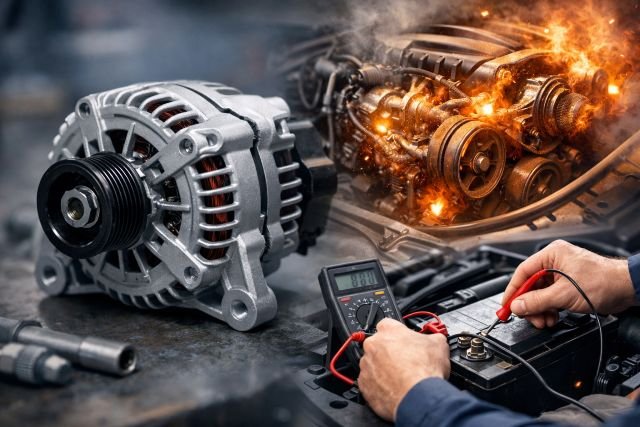
If you’ve been Googling how long do alternators last, you’re probably trying to avoid the classic scenario: the battery light pops on, the headlights start dimming, and suddenly you’re doing mental math about how far you can get before the car quits. The good news is that alternators are built to last. The more honest news is that their lifespan depends less on luck and more on what’s happening under the hood, especially heat, battery condition, and electrical load.
Most sources land in the same practical range: an alternator commonly lasts about 7 to 10 years or roughly 80,000 to 150,000 miles under normal driving and maintenance. That range is a useful benchmark, but it’s not a guarantee. Some alternators run well past 150,000 miles, while others fail much earlier when the charging system is under constant strain.
How long do alternators last on average?
On average, most drivers can expect an alternator to last 7–10 years or 80,000–150,000 miles. If you drive mostly highway miles, keep the battery healthy, and avoid chronic overheating, the alternator often stays happy longer. If you do lots of short trips, idle in heavy traffic, run high-draw accessories, or have a weak battery that never quite recovers, the alternator tends to age faster.
A helpful way to think about it is that alternators don’t “wear out” on a schedule like brake pads. They fail when the stresses add up, and the biggest stressors are usually heat and heavy output.
What the alternator really does, and why it eventually fails
People often describe the alternator as “the thing that charges the battery,” and that’s true, but it undersells the job. When the engine is running, the alternator powers most of the vehicle’s electrical demand in real time and also replenishes the battery after starting. If the alternator can’t keep up, the system starts borrowing from the battery, and that’s when warning lights and weird electrical issues begin.
Inside the alternator, electricity is produced as AC and then converted to DC by a rectifier (diodes), while a regulator manages voltage output. Those components live in a hot, vibration-heavy environment and deal with rapid changes in electrical demand. When you turn on the defroster, blower motor, headlights, or a big audio amplifier, the alternator’s workload jumps.
The alternator can handle that. What shortens its life is doing that for long stretches while baking in heat.
The truth about heat: the alternator’s most common enemy
Heat is the quiet destroyer in the engine bay. Even when the cooling system is working properly, under-hood temperatures get high, and alternators experience repeated heat cycles: cold start, warm-up, heat soak after shutdown, then repeat.
Rectifier diodes are especially sensitive to temperature, and overheating is widely cited as a major reason alternator diodes fail prematurely. When diodes degrade, you can see low output, charging instability, electrical “noise” (AC ripple), and in some cases battery drain symptoms that feel mysterious until the alternator is tested properly.
Heat-driven scenarios that shorten alternator life
Stop-and-go traffic is a perfect example. There’s less airflow, engine bay temps are higher, and electrical demand is often higher because fans and blowers are working harder. Frequent short trips are another sneaky one. Short trips don’t always give the battery enough time to fully recover from starting, which means the alternator spends more of its life in “catch-up mode,” producing higher output than it would on a steady long drive.
If your vehicle has had any overheating episodes, that matters too. Even one event can accelerate aging in electrical components, not just the alternator but also the battery and wiring.
Batteries and alternators: why a weak battery can shorten alternator life
This is where a lot of people get misled. When the car struggles to start, the battery gets blamed, the battery gets replaced, and the alternator is assumed fine. Sometimes that’s correct. Other times, the battery was the symptom, not the root cause.
A weak battery can make an alternator work harder than it should. If the battery is sulfated, internally damaged, or simply near end-of-life, it may accept charge inefficiently. That means the alternator stays under higher load for longer, producing more heat, which accelerates wear in the rectifier and regulator.
Heat also shortens battery life, which creates a feedback loop. The Car Care Council notes that excessive heat and overcharging are major reasons batteries have shortened life, and charging system issues like regulator problems can push charging rates too high. When the battery and alternator are both under stress, they can fail close together and make the repair feel like a “double hit.”
A practical takeaway is this: if you replace an alternator, it’s smart to evaluate the battery and charging system behavior, not just swap the part and move on. The same is true in reverse.
Wear and tear: what actually fails inside the alternator
Alternators typically fail in a few predictable ways, and each failure pattern has its own “personality.”
A failing diode pack can cause undercharging, unstable voltage, or ripple that creates strange electrical behavior. Overheating is a commonly cited cause of diode failure.
A failing voltage regulator can cause undercharging or overcharging. Overcharging can show up as unusually bright or flickering lights, shortened bulb life, battery swelling, or odd electrical behavior.
Bearing failure tends to announce itself with sound first, then worse performance later. If you hear a consistent whine, grinding, or rumble near the alternator area, don’t ignore it.
Belt issues can mimic alternator problems, too. A slipping belt can reduce alternator output and create charging problems that look like electrical failure. That’s why good diagnosis matters more than guessing.
Signs your alternator is going bad
Most alternators give some warning, but the warnings can be subtle at first.
The most obvious is the battery or charging warning light. Dimming headlights at idle, flickering dash lights, or electronics that act strangely can also be clues. The Drive notes that alternator testing often starts with inspecting belt condition and then checking battery voltage while the engine runs.
A common “real life” early sign is this: the car starts fine in the morning, but after a few days you notice it cranks slower, or you need a jump unexpectedly. People often assume “bad battery,” but repeated battery problems can also be a charging problem.
How to test your alternator the right way
A quick voltage check can tell you a lot, but it’s important to interpret it correctly.
With the engine running, a typical charging range often lands around the mid-13s to mid-14s volts. The Drive describes a common expectation of roughly 13.5 to 15 volts with the engine running during a basic multimeter test. Bosch’s alternator testing guidance includes observing that voltage should be around 13.5V at full load for a specific alternator in a test context, with service needed if it drops below spec.
If voltage is low, it could be the alternator, belt slip, wiring resistance, or battery condition. If voltage is high, it may suggest regulator control issues that can damage the battery and electronics over time.
Also, basic voltage alone doesn’t always reveal diode problems. Diode issues can create ripple and electrical noise that doesn’t show up as a dramatic voltage drop but can still cause symptoms. When the situation is confusing, a shop-grade test that checks ripple and load performance is worth it.
How to make an alternator last longer in the real world
If you want a longer alternator lifespan, you don’t need to “drive gently.” You need to reduce heat stress and avoid forcing the alternator into constant high-output recovery.
Battery health is the biggest lever. A battery that’s nearing end-of-life can keep the alternator in heavy-charge mode longer than normal. If you do lots of short trips, occasional longer drives can help the battery reach a fuller state of charge so the alternator isn’t always catching up.
Electrical connections matter more than most people think. Resistance from corrosion or loose connections can distort the charging system’s behavior and increase stress. If you ever see crusty battery terminals or weak grounds, fixing that is cheap insurance.
Heat management is partly “where you live and how you drive,” but it’s also maintenance. If the engine cooling system is struggling, everything under the hood suffers. Keeping cooling in good shape indirectly protects charging components.
Accessory load matters too. If you’ve added high-demand aftermarket equipment, an alternator may be asked to do more than the factory design expected, which can shorten lifespan. That doesn’t mean you can’t run accessories; it means you should make sure the electrical system is built for it.
FAQ: featured snippet-friendly answers
How long do alternators last in miles?
Most alternators commonly last around 80,000 to 150,000 miles, though real lifespan depends on heat exposure, electrical load, and maintenance.
How long do alternators last in years?
A typical alternator lifespan is about 7 to 10 years for many vehicles under normal conditions.
What causes alternators to fail early?
Heat, heavy electrical load, frequent short trips, and weak battery condition are common contributors. Overheating is often cited as a key cause of diode failure in alternators.
What voltage should an alternator show?
A basic test often shows charging around the mid-13s to mid-14s volts, and some guidance cites approximately 13.5 to 15 volts with the engine running depending on the vehicle and conditions.
Conclusion: how long do alternators last, really?
So, how long do alternators last when you factor in real driving and real heat? For many vehicles, the practical expectation is still 7–10 years or 80,000–150,000 miles. The “truth,” though, is that alternators usually don’t die randomly. They die when heat, heavy electrical output, and battery-related strain stack up long enough to wear down diodes, regulators, and bearings. Overheating is widely cited as a major factor in alternator diode failure, and battery/charging system issues can shorten component life on both sides of the relationship.
If you want to stretch alternator life, focus on the boring wins: keep the battery healthy, keep connections clean, pay attention to early warning signs, and don’t ignore heat-related issues. That’s how you stay out of the “dead battery light at night” club.