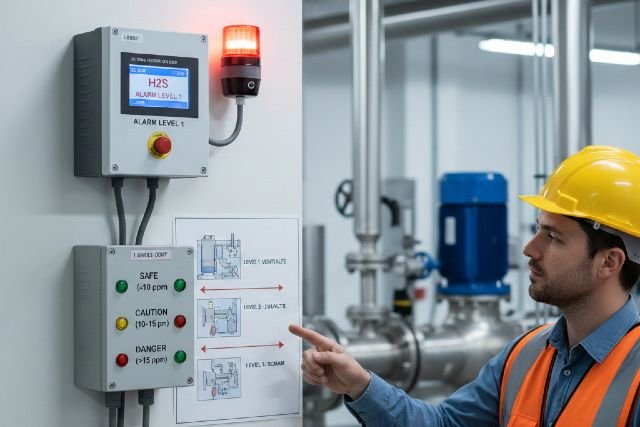
A hydrogen sulfide detector is one of the few safety tools that can warn you about a hazard your body can’t reliably sense. Hydrogen sulfide (H₂S) is a colorless gas often associated with a “rotten egg” smell, but that smell is not a dependable warning system. OSHA notes that after a while you can lose the ability to smell H₂S even when it’s still present, a phenomenon called olfactory fatigue. This matters because the environments where H₂S shows up most often, such as wastewater facilities, sewers, pits, tanks, and oil and gas sites, can change fast and trap gas in low-lying areas.
This article explains what alarm levels mean on an H₂S monitor, why the most common setpoints exist, how those alarm thresholds relate to OSHA, NIOSH, and ACGIH exposure limits, and how to choose alarm settings that protect people and keep your program compliant. You’ll also see realistic scenarios that show why “standard” alarms are not always the best alarms for your specific jobsite.
What alarm levels mean on a hydrogen sulfide detector
Alarm levels are preset concentration thresholds, usually measured in parts per million (ppm), that trigger audible, visual, and vibration alerts on a gas monitor. In plain terms, alarm levels translate a number on a screen into a required action. The moment your hydrogen sulfide detector alarms, your safety program should already define what happens next, because a delayed decision is often the most dangerous outcome.
Most modern H₂S monitors support at least a low alarm and a high alarm. Many also support time-based alarms like TWA and STEL. Low and high alarms respond to real-time concentration, while TWA and STEL respond to exposure over time. This distinction is important because a brief spike can be dangerous in a confined space, and a lower long-term exposure can still be a compliance issue even if it never triggers a high alarm.
Why you should never use smell to judge H₂S risk
The smell of hydrogen sulfide is widely known, but the reliability of smell is widely misunderstood. OSHA explicitly warns that you can smell the gas at low concentrations, but after a while you may lose the ability to smell it even though it remains in the air. The CDC’s NIOSH Pocket Guide also cautions that the sense of smell becomes rapidly fatigued and cannot be relied upon to warn of continuous presence.
In practical terms, that means a person who says, “I don’t smell it anymore, so we’re fine,” may actually be describing the start of a more dangerous situation. A hydrogen sulfide detector is designed to remove that uncertainty. If your team has ever used odor as a reason to keep working, it’s worth correcting that habit immediately in training and permitting.
The exposure limits that influence alarm setpoints
Alarm levels make the most sense when you anchor them to recognized exposure limits. Different organizations publish different limits, and your company may adopt one or more as policy. OSHA limits are enforceable in the U.S., while NIOSH and ACGIH limits are commonly used as best-practice benchmarks in industrial hygiene programs.
OSHA’s hydrogen sulfide hazards page lists a general industry ceiling limit of 20 ppm and a peak limit of 50 ppm for up to 10 minutes under specific conditions, and it also notes a NIOSH IDLH value of 100 ppm. The CDC’s NIOSH Pocket Guide similarly summarizes NIOSH REL as 10 ppm on a 10-minute ceiling basis, and it repeats OSHA’s ceiling and peak values.
ACGIH’s published TLV listing for hydrogen sulfide shows a TLV–TWA of 1 ppm and a TLV–STEL of 5 ppm. Those ACGIH numbers are much lower than what many field teams expect, and they’re often the reason some companies choose more conservative low alarms than the common “10/15” pattern.
A separate but critical concept is IDLH, or “Immediately Dangerous to Life or Health.” NIOSH sets the IDLH for hydrogen sulfide at 100 ppm. Many safety programs treat readings approaching that range as escape-only conditions unless workers are properly equipped with appropriate respiratory protection and entry procedures.
Common hydrogen sulfide detector alarm levels and what they’re trying to do
You’ll hear people refer to “standard” H₂S alarms, but in reality there are several common patterns. The best way to understand them is to focus on what each setpoint philosophy is trying to prevent.
One very common configuration in many field settings is a low alarm around 10 ppm and a high alarm around 15 ppm. This approach reflects the idea that 10 ppm is a serious action point, and it aligns conceptually with the NIOSH REL ceiling value of 10 ppm for 10 minutes. Many teams like this configuration because it reduces nuisance alarms and creates a strong “this is real” signal that is hard to ignore.
A more conservative approach sets the low alarm around 5 ppm and the high alarm around 10 ppm. This tends to fit programs that want earlier warning and that treat 5 ppm as a meaningful threshold because ACGIH’s TLV–STEL is 5 ppm. In environments where H₂S can build gradually or where ventilation is part of normal control strategy, earlier warning can prevent exposures from ever approaching ceiling-style limits.
The most hygiene-driven approach sets low alarms as low as 1 ppm and high alarms around 5 ppm, essentially mirroring ACGIH’s TLV–TWA and TLV–STEL values. This strategy can work very well in controlled facilities with strong calibration programs, stable work processes, and sensors proven to perform well at low ppm. It can also lead to frequent alarms if the environment has intermittent background H₂S or if response rules are not clearly defined.
What generally does not work as a “normal” low/high alarm strategy is using 20 ppm and 50 ppm as operational thresholds. Those numbers appear in OSHA references as ceiling and peak limits for general industry, but if your first alarm is 20 ppm you are already at the ceiling limit, and that’s a poor way to manage safety or compliance proactively.
How to pick alarm setpoints that are defensible and practical
A reliable method for choosing alarm setpoints is to align them with three layers: compliance, risk speed, and response capability.
The compliance layer asks which limits your organization must meet and which limits it has adopted as policy. OSHA provides enforceable limits and context for hydrogen sulfide hazards, while NIOSH and ACGIH provide recommended values that many companies adopt for stronger protection. If your written policy says you follow ACGIH TLVs, then your alarm plan should reflect that reality rather than operating as if OSHA ceilings are your only benchmark.
The risk speed layer asks how quickly H₂S can change in your specific work area. Confined spaces and low-lying areas can trap H₂S and shift rapidly, which supports earlier alarms because “wait and see” is not a safe strategy. OSHA’s pages emphasize the hazards and the need for proper evaluation and control rather than relying on sensory cues.
The response capability layer asks what your team will actually do when the alarm goes off. If you set very low alarms but your team has no clear “investigate and control” procedure, workers may learn to ignore alarms, which defeats the purpose. Conversely, if you set alarms too high, you may discover a dangerous situation only when you’ve already crossed an exposure threshold you intended to avoid.
A practical way to balance these layers is to treat the low alarm as the point where you pause, move to cleaner air, and reassess controls, while the high alarm is the point where you stop work and evacuate. Your permits and JSAs should state those actions clearly. An internal-link structure that supports this kind of training could include pages like /confined-space-safety, /gas-monitoring-best-practices, and /h2s-safety-training.
What to do when the detector alarms in the real world
When a hydrogen sulfide detector alarms, people often lose time debating whether the device is “being sensitive.” The safer approach is to treat alarms as valid until you have evidence otherwise.
At a low alarm, the safest immediate move is to stop the task, move toward cleaner air, and evaluate what changed. In outdoor environments, that usually means moving upwind and away from low spots. In enclosed environments, it often means pausing work, improving ventilation, and confirming conditions before continuing. If the work is under a confined space permit, your permit triggers should dictate whether you exit and reauthorize entry.
At a high alarm, the safest baseline response is to evacuate immediately and follow site emergency procedures. High alarms should not be treated as “investigate while staying put,” because the monitoring point is typically in the breathing zone, and a rising reading indicates increasing exposure risk. IDLH context matters here because NIOSH defines hydrogen sulfide IDLH as 100 ppm, highlighting how quickly conditions can become life-threatening.
TWA and STEL alarms, explained in plain language
Many workers understand low and high alarms but feel uncertain about TWA and STEL. A useful way to think about them is that low and high alarms are about “what is happening now,” while TWA and STEL alarms are about “what your body is accumulating over time.”
TWA is typically based on an 8-hour time-weighted average. If your monitor computes TWA and it trends upward, it means your overall shift exposure is becoming significant even if you never hit a dramatic peak. This matters for chronic exposure control and for companies aligning to lower limits such as ACGIH’s 1 ppm TWA.
STEL is a short-term exposure limit, commonly 15 minutes in industrial hygiene practice. ACGIH’s TLV–STEL for H₂S is 5 ppm. If your monitor supports a STEL alarm, it can prevent the “it’s only a few minutes” problem, where a series of moderate readings turns into an unacceptable short-term exposure.
If your program uses OSHA’s ceiling framework, you may still benefit from TWA and STEL alarms as early warnings. OSHA’s general industry ceiling and peak values do not automatically protect workers from repeated moderate exposures that add up over a shift, which is why many employers adopt stricter internal guidance.
Scenarios that show why alarm levels matter
Consider a wastewater lift station where opening a hatch produces brief readings of 6 to 8 ppm that drop when ventilation improves. A 5 ppm low alarm alerts the crew early, prompting a pause and ventilation adjustment before anyone spends 15 minutes near the opening. That aligns well with a program that respects ACGIH’s 5 ppm STEL as a meaningful boundary. A 10 ppm low alarm might never trigger in that scenario, and the crew might unknowingly accept repeated short-term exposures that the program would prefer to avoid.
Now consider a tank cleaning job where a worker’s personal monitor jumps quickly to 25 ppm. In that moment, arguing about whether the monitor is “right” wastes precious time. OSHA’s general industry ceiling is 20 ppm, and exceeding it indicates you have already crossed a serious boundary. In a well-designed program, your alarms should have triggered earlier so the response starts before you reach the ceiling.
A third scenario involves odor complaints with low readings. A worker reports “rotten egg smell,” but the monitor reads zero. This can happen if the odor source is not H₂S, or it can happen if the sensor is not responding correctly. OSHA’s guidance reminds you not to rely on smell, and the NIOSH Pocket Guide reinforces that smell fatigue can mislead you. In this situation, your program’s answer should be to verify the instrument with a bump test and confirm calibration status rather than deciding based on odor reports.
Calibration and bump testing: the difference between real safety and false confidence
Alarm setpoints are only useful if the sensor is trustworthy. A bump test is a functional check that confirms the sensor responds to gas and triggers alarms. Calibration adjusts the sensor to match a known concentration standard. When these steps are skipped or done inconsistently, the most dangerous outcome is not an obvious failure. The most dangerous outcome is a quiet failure where the detector shows reassuring numbers while the hazard is real.
Personal monitors versus fixed systems: whose alarm do you follow?
A personal hydrogen sulfide detector gives you breathing-zone information. It is the closest proxy for what a person is actually inhaling. Fixed and area monitors are valuable for early warning and site-wide awareness, but they can be affected by placement, airflow patterns, and distance from the source.
The safest rule in most programs is that personal monitor alarms take priority for immediate worker action, because they represent the concentration where the worker is located. Area alarms are then used to coordinate broader operational response, such as isolating a process, increasing ventilation, or restricting access.
FAQ-style answers for featured snippets
A common question is what the standard alarm level is for H₂S. The most accurate answer is that there is no single universal standard, but many sites use a low alarm around 10 ppm because NIOSH lists a 10 ppm 10-minute ceiling REL, and because 10 ppm is widely treated as a strong action point in field programs.
Another common question is whether 10 ppm is dangerous. Ten ppm deserves respect because it can indicate a deteriorating atmosphere, particularly in a confined space, and because recommended limits treat it as a ceiling-style boundary. For emergency planning, it is also important to remember that NIOSH defines the IDLH for hydrogen sulfide as 100 ppm, which underscores how quickly conditions can become life-threatening as concentrations rise.
People also ask why the detector alarms when they cannot smell anything. OSHA explains that you can lose your ability to smell the gas even though it is still present, meaning a lack of odor is not a safety indicator.
Another frequent question is whether a low alarm should be 5 ppm or 10 ppm. The best answer depends on which exposure benchmark your program follows and what your response plan is. If your program aligns with ACGIH’s TLV–STEL of 5 ppm and prioritizes early warning for short-term exposures, a 5 ppm low alarm often makes operational sense. If your program emphasizes decisive action at higher but still conservative thresholds, and you want to reduce nuisance alarms, 10 ppm remains a widely used action point consistent with NIOSH’s ceiling framework.
Conclusion: make your alarm levels protect people and prove compliance
A hydrogen sulfide detector is not just a device you wear to satisfy a rule. It’s a decision tool that should translate exposure science into immediate, consistent action. OSHA’s resources emphasize that you cannot rely on smell because olfactory fatigue can occur even while hydrogen sulfide remains present. NIOSH and the CDC provide clear exposure limit context, including a 10 ppm ceiling-style REL and a 100 ppm IDLH value that highlights the need for fast evacuation decisions at higher readings. ACGIH’s TLV values, including 1 ppm TWA and 5 ppm STEL, explain why many companies choose more conservative alarm strategies to reduce both acute and cumulative risk.
If you want to stay safe and stay compliant, choose alarm setpoints intentionally, connect them to your written standard, and train responses so that a beep triggers action, not debate. When the alarm logic, the exposure limits, and the on-the-job behavior all line up, your hydrogen sulfide detector becomes what it should be: an early warning that gives workers time to get out, reset controls, and go home safe.