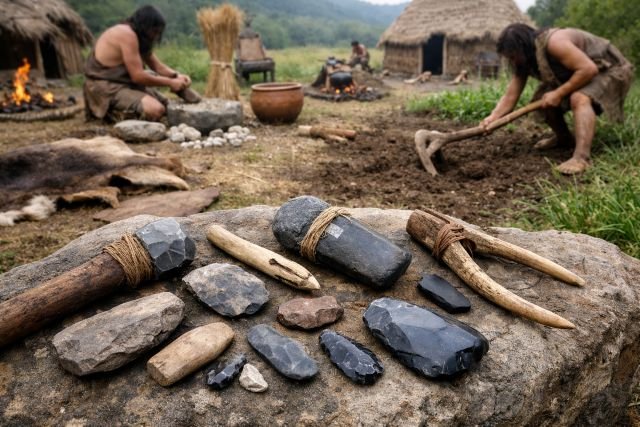
The story of early farming, village life, and lasting human progress can’t be told without neolithic tools. These weren’t just objects made from stone, bone, and wood — they were the technology that allowed people to clear forests, plant crops, store food, build houses, and create permanent settlements. In many ways, neolithic tools were the “infrastructure” of the first agricultural societies, helping early humans transition from mobile hunting and gathering to organized farming and community life.
What makes neolithic tools so fascinating is that they reveal more than what people made; they reveal what people valued. A polished stone axe was not only practical for woodcutting — it could represent skill, status, and even long-distance exchange. Grinding stones didn’t only process grain — they reflect the birth of daily routines that still resemble our own. This article explores how neolithic tools were made, how they were used, and why they changed human history forever, backed by research and museum evidence.
What Are Neolithic Tools? A Clear Definition
Neolithic tools are the implements used by humans during the Neolithic period, sometimes called the “New Stone Age,” when farming and permanent settlement expanded across many regions. The Neolithic is widely characterized by tools shaped through grinding and polishing, along with increasing reliance on domesticated plants and animals.
Unlike earlier Stone Age periods, where stone tools were mainly chipped, Neolithic societies developed refined techniques to create smoother, sharper, and more durable working edges. This innovation was not a minor improvement — it transformed what humans could build, grow, and produce consistently.
The Neolithic Revolution and Why Tools Suddenly Mattered More
To understand neolithic tools, you have to understand what changed in human life. The Neolithic period is closely linked with the Neolithic Revolution, a major shift from foraging to food production, and from mobility to permanent settlement.
When communities began to farm, their priorities changed. Farming demanded new technologies: tools to clear trees, cultivate soil, harvest cereals, grind grain into edible flour, and store food safely. A farming lifestyle also encouraged more specialized labor, meaning some individuals became skilled toolmakers, improving production quality over time.
This transition also affected population growth and settlement size. Agriculture can produce far more calories per area than foraging, which is one reason farming societies expanded and intensified the need for reliable tools.
The Biggest Innovation: Grinding and Polishing in Neolithic Toolmaking
One of the defining features of neolithic tools is the rise of ground and polished stone technology. Earlier stone tools were often chipped into shape through flaking. Neolithic craftspeople still used flaking to rough out a tool, but then improved it with pecking, grinding, and polishing to strengthen the edge and reduce breakage.
Polishing made axes, adzes, and chisels more efficient for woodworking and heavy-duty tasks. The result was a tool that could withstand repeated impact and remain sharper longer. Archaeological discussions of Neolithic technology consistently emphasize polishing as a major leap in durability and precision.
This technical improvement may sound subtle, but it changed daily life. A sharper axe can fell trees faster. A durable adze can shape beams more effectively. Over time, those efficiencies translate into larger farms, stronger houses, and greater food security.
Neolithic Stone Axes: The Tool That Helped Create Farms
Among all neolithic tools, the polished stone axe is the symbol of the era. Axes allowed early farmers to clear forests for fields and gather timber for houses, fences, and storage buildings. Museums across Europe hold polished Neolithic axes, confirming their size, craftsmanship, and standardized forms.
Recent research using use-wear analysis shows that many Neolithic polished axes were used for woodworking, supporting their role in forest clearance and settlement-building as agriculture spread.
It’s also important to understand that axes weren’t just “tools.” In many regions, they circulated across long distances through trade and exchange. Their material often came from specific quarries, meaning an axe could represent connections between communities. Even when not in use, axes were sometimes deposited in ways that suggest symbolic importance, showing that neolithic tools carried social meaning too.
Adzes, Chisels, and Woodworking Tools: Building the First Villages
If axes cleared the forest, adzes and chisels built the village. Adzes are woodworking tools designed for shaping and smoothing wood, often used to carve beams, hollow logs, or flatten surfaces. Chisels helped create joinery and fine shaping.
As Neolithic life became more settled, woodworking became more complex. People weren’t just building temporary shelters; they were constructing long-lasting homes, storage structures, and enclosures. In many archaeological summaries of Neolithic toolkits, adzes, wedges, and chisels appear alongside axes as central tools of village life.
Even if the materials were simple, the craftsmanship was often sophisticated. A polished edge combined with the right handle could make a stone tool remarkably effective, especially when paired with the repetitive labor of experienced builders.
Sickle Blades and Harvesting Tools: The Technology of Agriculture
Farming societies needed a way to harvest cereals efficiently. This is where flint blades, sickle inserts, and cutting tools became critical.
Early sickles were often composite tools. Rather than being one solid blade, they were made by attaching several flint blades into a curved wooden or bone handle, held in place with resin or binding. This design allowed quick replacement of dulled blades and created a longer cutting edge.
Harvesting tools didn’t just increase efficiency; they changed diet and survival. By harvesting cereals and storing grain, communities could withstand seasonal scarcity. That stability helped support larger families and more permanent settlement patterns, which is a consistent theme in discussions of the Neolithic transition.
Grinding Stones, Querns, and Food Processing: The Quiet Revolution
If there’s one category of neolithic tools that shaped everyday routine more than any other, it’s food-processing tools. Farming isn’t only about growing crops — it’s about turning raw grain into edible food. Neolithic societies developed grinding stones, mortars, pestles, and querns to process cereals into flour and meal.
Grinding stones also carry important evidence for archaeologists. Wear patterns can show how tools were used, what types of food were processed, and how frequently grinding occurred. This matters because it reveals not just technology, but daily labor patterns, including the shift toward repetitive domestic work within settled societies.
From a survival perspective, grinding stones helped unlock calories. A whole grain is harder to digest than flour, and cooking ground grain increases nutritional availability. This means grinding tools weren’t optional; they were essential for making agriculture viable at scale.
Hunting Tools Didn’t Disappear: Neolithic Toolkits Were Mixed
Even after farming spread, hunting and gathering continued in many communities. Neolithic toolkits often included projectile points, scrapers, and knives used for hunting, hide processing, and craftwork. The Neolithic was not a clean break from earlier life — it was a blend of new and old strategies.
Archaeological descriptions of Neolithic tools frequently include scrapers, borers, and cutting implements alongside farming tools. This confirms that early farmers still relied on animal products, fishing, and wild resources.
This mixed toolkit makes sense. Farming was risky, especially in early stages. Crop failure, weather shifts, or soil depletion could threaten survival, so hunting remained a crucial backup and supplement.
How Neolithic Tools Shaped Social Change and Specialization
Neolithic tools did more than improve survival. They created the conditions for social complexity.
Once food could be produced and stored in surplus, not everyone needed to spend all day acquiring food. That allowed specialization, where some individuals focused on toolmaking, pottery, weaving, or building. Encyclopedic summaries of the Neolithic often highlight pottery and weaving emerging alongside polished tools and permanent settlement.
Tool specialization also suggests knowledge transmission. Grinding and polishing require skill, patience, and technique — something that develops through learning. Over generations, communities became better at tool production, and those improvements reinforced the success of farming life.
Real-World Scenario: How a Neolithic Family Used Tools to Survive
Imagine a Neolithic household living near a forest edge.
At sunrise, someone uses a stone axe to cut small timber for fuel and maintenance. Another person uses flint blades to harvest grain in a nearby field. Later, someone sits for hours grinding grain on a quern to prepare flour for cooking. A scraper tool is used to clean hides from an animal, while another tool drills holes in bone for ornaments or repairs.
This is what makes neolithic tools so important. They weren’t used once in a while. They structured daily life. They determined whether food was ready on time, whether shelters survived storms, whether fields could expand, and whether stored grain lasted through winter.
What Neolithic Tools Tell Us About Early Human Intelligence
Neolithic tools reveal problem-solving at scale. They show that early humans understood materials, durability, ergonomics, and long-term planning.
Grinding and polishing represent a commitment to future use. You don’t polish stone unless you plan for the tool to last. That mindset reflects a deeper shift in human behavior: the rise of settled life encouraged investment in durable technology.
This is why the Neolithic is considered a major turning point in human development. It’s not just the tools — it’s what the tools represent: long-term thinking, community organization, and adaptation to new environments.
Common Questions About Neolithic Tools (FAQ)
What are neolithic tools used for?
Neolithic tools were used for farming, harvesting crops, processing food, woodworking, building houses, hunting, and crafting. They supported settled life by making agriculture and construction more efficient.
What is the most important Neolithic tool?
The polished stone axe is often considered the most important because it enabled forest clearance, woodworking, and construction — key activities for farming societies and permanent villages.
How were neolithic tools different from Paleolithic tools?
Neolithic tools were more often ground and polished, making them smoother, sharper, and more durable than earlier chipped stone tools. This reflected new needs like woodworking and farming.
Did Neolithic people still hunt?
Yes. Even with farming, many Neolithic communities continued hunting and gathering. Toolkits often included scrapers, projectile points, and cutting tools for processing animals and wild resources.
Why did toolmaking improve so much in the Neolithic?
Toolmaking improved because farming and settled life required stronger, more reliable tools. Grinding and polishing techniques produced more durable edges, helping communities build structures, clear land, and process food efficiently.
Conclusion: Why Neolithic Tools Still Matter Today
From polished stone axes to grinding stones and harvesting blades, neolithic tools were the technology that made farming, building, and settled life possible. They helped early humans clear forests, cultivate crops, process grain into edible food, and construct permanent villages — laying the foundation for population growth and complex societies. The Neolithic period is widely defined by this shift toward polished tools, agriculture, and permanent settlement, making tool innovation central to one of humanity’s biggest transformations.
When you look at neolithic tools, you’re not just looking at stone and wood — you’re looking at the earliest version of human engineering. These tools represent adaptation, planning, skill, and community life, and they remind us that civilization didn’t begin with metal or machines. It began with the first people who learned to grind stone, harvest grain, and build a world that could last.