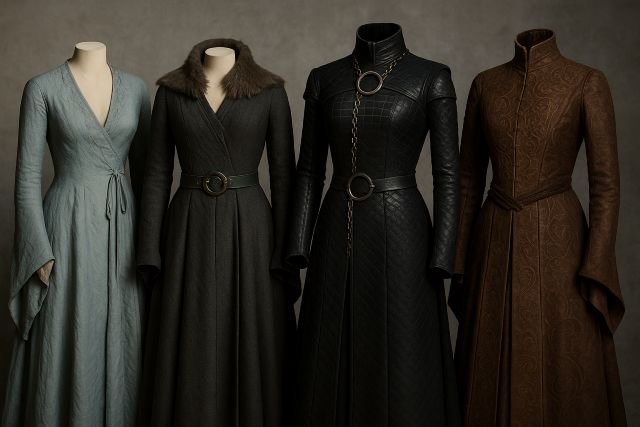
In Game of Thrones, fashion was far more than visual flair — it was a language of power, identity, and transformation. Among all the meticulously crafted wardrobes, the Sansa costume stands out as one of the most symbolic and emotional journeys in television history.
From soft pastels and floral embroidery to dark armor-inspired gowns, Sansa Stark’s wardrobe evolved in parallel with her character — from a naïve girl dreaming of courtly life to the resilient Queen in the North.
The evolution of the Sansa costume perfectly mirrors her path from innocence to empowerment, making her one of the most visually dynamic characters in the entire series.
The Early Seasons: Innocence in Silks and Pastels
When audiences first meet Sansa Stark in Season 1, her wardrobe reflects her sheltered upbringing in Winterfell and her admiration for Southern sophistication.
Color Palette and Fabric Choices
- Soft blues, lilacs, and ivory tones symbolized her innocence and purity.
- Light silks and velvets reflected her desire to fit into the highborn world of King’s Landing.
- Floral embroidery and delicate stitching emphasized her romanticism and youth.
| Aspect | Design Symbolism |
|---|---|
| Color Palette | Pastels for innocence and submission |
| Textures | Silks and light fabrics for fragility |
| Embroidery | Flowers representing youthful dreams and naivety |
| Silhouette | Flowing gowns echoing traditional noble fashion |
“Sansa’s early costumes were intentionally delicate — she’s trying to become something she isn’t yet,” explained costume designer Michele Clapton in an interview with Vogue.
At this stage, her clothes represent aspiration — a Northern girl attempting to embody a Southern lady’s grace.
King’s Landing Era: Control, Conformity, and Survival
As Sansa becomes a pawn in political games, her wardrobe begins to shift dramatically. Her Sansa costume becomes a reflection of entrapment and adaptation.
Blending In with the Lannisters
- Her palette darkens to maroons and golds — the colors of House Lannister, her captors.
- She begins to wear high-necked gowns and structured bodices, symbolizing restraint and control.
- Her hairstyles mimic Queen Cersei’s — a strategic imitation that signals survival.
This was the era of fashion as armor. Sansa learned to use clothing as camouflage, aligning herself visually with her oppressors to stay safe.
“When she mimics Cersei’s style, it’s her only form of protection — she’s learning how to survive the game,” said Clapton in a Harper’s Bazaar interview.
The Transition: Darker Tones and Personal Identity
Following her escape from King’s Landing, Sansa’s wardrobe takes on a distinctly darker and more somber tone. This marks the start of her self-awareness and quiet rebellion.
The Black Feather Gown (Season 4)
Perhaps one of her most iconic early transformation moments, Sansa appears in a gown adorned with black feathers after escaping King’s Landing. The design signals:
- Freedom through transformation — shedding her old identity.
- Influence of Littlefinger — her darker mentorship phase.
- A metaphorical “bird” taking flight, both literally and symbolically.
The black gown established the beginning of Sansa’s reclamation of agency. It was no longer the clothing chosen for her, but by her.
The Northern Renaissance: Return to Heritage
When Sansa returns to Winterfell, her wardrobe once again draws inspiration from her Northern roots. But this time, she wears it with purpose and authority.
Key Costume Features
- Heavy wool and fur layers to reflect the Northern climate and leadership.
- Stark sigils subtly embroidered into the fabric.
- Deep greys, blues, and blacks — symbolizing loyalty to her house and wisdom gained from suffering.
| Costume Element | Meaning |
|---|---|
| Fur Mantles | Protection, leadership, connection to family heritage |
| Dark Palette | Strength, maturity, self-control |
| Intricate Stitching | Hidden symbolism, personal agency |
| Metal Clasps and Brooches | Armor-like details showing readiness for battle and responsibility |
By embracing Winterfell’s rugged textures and solemn tones, Sansa finally reclaims her identity. Her costume becomes her crown — rooted in tradition but shaped by experience.
Queen in the North: The Ultimate Sansa Costume
The final episode of Game of Thrones features Sansa Stark’s most iconic look — the Queen in the North coronation gown — a masterpiece of storytelling through design.
Design Breakdown
- Material: Rich velvet and metallic embroidery.
- Color: Charcoal gray with silver thread — echoing both the direwolf and Winterfell’s icy resilience.
- Silhouette: Structured shoulders and long sleeves, mirroring armor more than a dress.
- Accessories: A direwolf-embossed belt and a metal crown adorned with Northern leaves and wolves.
This Sansa costume represents self-sovereignty. Every stitch reflects her journey from a manipulated girl to a powerful woman who commands her destiny.
“Her coronation dress was her battle armor,” Clapton noted. “It was everything she had become — Northern, strong, and entirely her own.”
Symbolism in Sansa’s Costumes: A Visual Timeline of Empowerment
The evolution of Sansa’s wardrobe tells her life story in fabric form.
| Season | Fashion Era | Symbolism |
|---|---|---|
| 1–2 | Soft colors, florals | Innocence and romantic idealism |
| 3–4 | Regal reds, corseted gowns | Control and captivity |
| 5–6 | Dark hues, feathers | Rebirth and awakening |
| 7–8 | Fur, armor-inspired dresses | Authority, independence, and leadership |
Each transformation corresponds not just to her circumstances but to her state of mind. The Sansa costume serves as both visual narrative and emotional expression.
The Role of Costume Design in Character Development
Costume designer Michele Clapton’s work on Sansa Stark is now studied in film and fashion schools for its narrative power.
Design Philosophy
- Every stitch tells a story.
- Clothing evolves with the character’s psyche.
- Symbolism is embedded in details — from embroidery to fabric weight.
Clapton’s approach reflects the fusion of storytelling and textile art, showing how the Sansa costume contributes to the series’ emotional depth.
“Clothing is identity. When Sansa begins to dress herself, that’s when she becomes herself,” said Clapton in a Behind the Scenes featurette by HBO.
The Influence of Sansa Costume on Pop Culture
The Sansa costume has transcended television — inspiring cosplay, fashion editorials, and designer collections worldwide.
Cultural Impact
- Fashion houses like Alexander McQueen and Elie Saab have cited Game of Thrones as inspiration for regal silhouettes.
- Cosplayers recreate Sansa’s iconic feathered gown and coronation dress as tributes to empowerment.
- Feminist discussions often reference her costume arc as an allegory for women reclaiming autonomy.
On social media, hashtags like #SansaStarkStyle and #QueenInTheNorth continue to trend, showing the enduring fascination with her wardrobe.
Modern Interpretations: Sansa’s Style Beyond the Screen
Even after Game of Thrones ended, Sansa’s legacy—both as a character and a style icon—continued.
- Sophie Turner, who portrayed Sansa, often incorporates similar regal aesthetics in her red-carpet looks.
- Designers at fan conventions reinterpret her gowns into modern power-dressing ensembles, blending medieval inspiration with contemporary fashion.
- The minimalist yet commanding silhouettes of Sansa’s later costumes have influenced fantasy and historical fashion in shows like The Witcher and House of the Dragon.
FAQs About the Sansa Costume
1. Who designed the Sansa costume in Game of Thrones?
The costumes for Sansa Stark were designed by Michele Clapton, an award-winning British costume designer responsible for the show’s detailed wardrobe storytelling.
2. What inspired Sansa’s final Queen in the North costume?
It drew inspiration from Northern culture, medieval armor, and Stark symbolism — representing resilience, leadership, and autonomy.
3. How did Sansa’s wardrobe change through the series?
Her outfits evolved from light, romantic gowns to dark, armor-like dresses, mirroring her transformation from innocence to empowerment.
4. What materials were used in Sansa’s costumes?
Designers used rich fabrics such as velvet, wool, fur, and leather — combining femininity with elements of strength and endurance.
5. Why is the Sansa costume important to the story?
Because it visually narrates Sansa’s growth and resilience, reflecting her psychological and political evolution throughout the series.
Conclusion: The Sansa Costume — Power Woven in Thread
The Sansa costume is one of television’s finest examples of storytelling through fashion. It chronicles her evolution from a naive dreamer into a decisive ruler, using every stitch, shade, and fabric to echo her growth.
By the final episode, Sansa’s clothing no longer imitates anyone else’s — it defines her own sovereignty. Her attire becomes a form of language, a visual testament to survival, intelligence, and grace under fire.