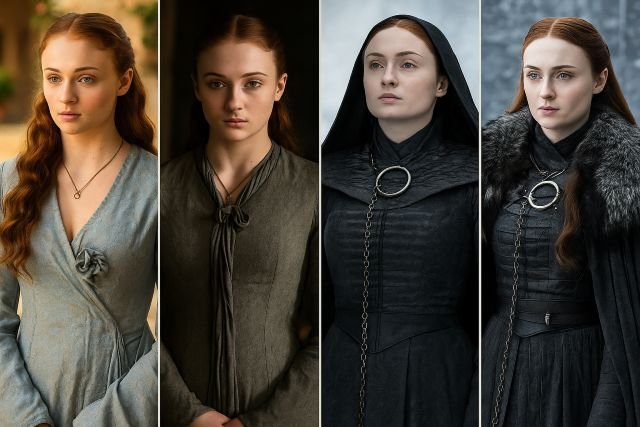
In Game of Thrones, costumes were never just aesthetic — they were storytelling tools. Among the most visually powerful wardrobes in the series were the Sansa Stark outfits, designed by the brilliant Michele Clapton. Every color, fabric, and silhouette in Sansa’s wardrobe traced her evolution from a naive Northern girl to the powerful Queen in the North.
This deep dive into the Sansa Stark outfits explores how fashion became a mirror of her psyche — charting her journey through innocence, trauma, empowerment, and leadership.
The Role of Costume in Game of Thrones
Before exploring Sansa’s wardrobe specifically, it’s important to understand Game of Thrones’ approach to costume design. The show’s costume team, led by Michele Clapton and textile artist Michele Carragher, aimed to make clothing as emotionally expressive as dialogue.
“Clothing was our visual language,” Clapton told Vogue. “Each thread told part of the story that might never be spoken aloud.”
In a world where power, survival, and deception ruled, what a character wore said everything about who they were and what they had become.
For Sansa Stark, costume became her armor and identity — both a reflection and a defiance of her circumstances.
Season 1–2: The Innocence of Winterfell
When we first meet Sansa Stark in Season 1, she is the picture of youthful idealism — dreaming of marrying a prince and becoming a queen. Her early outfits reflect this innocence.
Design Characteristics
| Element | Symbolism |
|---|---|
| Colors: Pale blues, lilacs, creams | Purity, naivety, and hope |
| Fabrics: Light silks and linen | Comfort and Northern simplicity |
| Embroidery: Floral motifs | Youth and romantic imagination |
| Silhouette: Flowing dresses | Freedom and femininity |
Sansa’s dresses resemble her mother’s (Catelyn Stark) — traditional, graceful, and unassuming. Her wardrobe at this stage mirrors her unquestioned belief in noble ideals and Southern courtly culture.
Her clothes are her dreams made visible — soft, delicate, and full of illusion.
Season 2–4: Confinement and Conformity
When Sansa moves to King’s Landing, her wardrobe darkens — visually symbolizing her loss of freedom and increasing entrapment in Lannister politics.
The Influence of the Lannisters
In King’s Landing, Sansa learns to dress for survival. Her once-bright Northern tones fade into Lannister reds, golds, and deep burgundy hues — colors she adopts to blend in and avoid suspicion.
- Structured corsets and high collars: Reflect control and oppression.
- Rich brocades and embroidery: Imitate courtly style, showing forced assimilation.
- Cersei-inspired hairstyles: Copying her captor’s look becomes an act of disguise.
The Sansa Stark outfits in these seasons are her armor of submission — beautiful on the outside, but imprisoning within. Her attire tells of a woman learning to survive through silence and conformity.
“Her dresses were her prison,” Clapton explained to Harper’s Bazaar. “They looked regal, but they weren’t her.”
Season 5: The Black Feather Gown — Rebirth and Resistance
One of the most defining Sansa Stark outfits appears in Season 5 — the black feather dress she wears after escaping King’s Landing. This moment represents her transformation from victim to strategist.
Symbolism of the Black Feather Dress
| Feature | Meaning |
|---|---|
| Color: Black | Mourning, rebirth, strength |
| Feather Details | “Little bird” metaphor turned symbol of freedom |
| Structured Design | Self-protection and newfound control |
| Heavy Texture | Transition from fragility to resilience |
This outfit is both defensive and defiant. For the first time, Sansa chooses her clothing, declaring her autonomy through darker tones and tailored silhouettes.
The feathers represent flight — not away from danger, but toward power.
Season 6–7: The Northern Renaissance
Upon returning to Winterfell, Sansa’s wardrobe evolves once again — this time reclaiming her Stark identity. Her fashion reflects both her heritage and leadership.
Northern Identity in Costume
- Heavy wools, furs, and leather — practicality and Northern resilience.
- Dark greys and blues — somber, intelligent, and dignified.
- Wolf sigils embroidered into her clothing — loyalty and self-assertion.
- Layered silhouettes — mirroring her emotional and psychological complexity.
Her outfits are not about beauty anymore — they’re about authority. She dresses as someone who belongs to Winterfell but no longer depends on others to define her.
“Her costumes became her armor,” said Clapton. “Everything was designed to protect her, both physically and emotionally.”
Season 8: The Queen in the North
The final evolution of the Sansa Stark outfits culminates in her coronation gown — one of the most iconic costumes in television history.
Coronation Gown Breakdown
| Design Element | Symbolism |
|---|---|
| Material: Velvet and metal thread | Power, strength, sovereignty |
| Color Palette: Silver-grey | Wisdom and unity |
| Embroidery: Weirwood leaves and direwolves | Northern heritage |
| Cloak with fur trim | Family lineage and leadership |
| Crown of leaves and wolves | Connection to nature and her people |
This gown is the ultimate statement of self-definition. Every thread honors her journey — the colors of Winterfell, the resilience of the North, and the calm strength of a queen.
Sansa’s final outfit is not about fashion — it’s about legacy.
The Evolution of Sansa Stark Outfits: A Timeline
| Season | Style Focus | Symbolism |
|---|---|---|
| 1–2 | Light silks, floral embroidery | Innocence, hope |
| 3–4 | Lannister tones, tight structure | Conformity, loss |
| 5 | Black feathers, tailored design | Rebirth, control |
| 6–7 | Furs, embroidery, armor-like | Strength, leadership |
| 8 | Royal velvet, metallic embroidery | Sovereignty, wisdom |
Each transformation in Sansa’s wardrobe reflects her inner strength — a slow but steady evolution from dreamer to leader.
The Psychology of Sansa’s Wardrobe
Sansa’s clothing isn’t just political — it’s psychological. Every choice mirrors her mental and emotional state.
Key Fashion Psychology Themes
- Color transitions = Emotional metamorphosis
- Textures and fabrics = Comfort versus control
- Embroidery = Communication through hidden storytelling
- Armor-like designs = The embodiment of trauma and protection
In an HBO interview, Clapton described Sansa’s wardrobe as “a diary written in thread.”
This concept — fashion as emotional storytelling — is what elevates Sansa Stark outfits from costumes to works of art.
Michele Clapton’s Genius: Storytelling Through Fashion
The costume design for Game of Thrones earned Michele Clapton multiple Emmy Awards and worldwide acclaim. Her genius lies in her ability to turn clothing into narrative symbolism.
Clapton’s Design Approach
- Research & Authenticity – Drawing from medieval and Northern European fashion.
- Symbolism in Detail – Hidden motifs representing family and fate.
- Character-Driven Evolution – Costumes grow with the storyline, not against it.
- Textile Craftsmanship – Collaboration with artisan embroiderers for realism.
“Sansa’s story is told visually. Her embroidery, her materials — everything has meaning,” Clapton noted in HBO’s Behind the Scenes documentary.
Her approach influenced a generation of fantasy costume designers in shows like The Witcher, House of the Dragon, and The Rings of Power.
Impact of Sansa Stark Outfits on Fashion and Pop Culture
The influence of Sansa Stark outfits extended far beyond television screens.
1. Influence on Runway Fashion
Designers such as Alexander McQueen, Elie Saab, and Valentino drew inspiration from Sansa’s regal Northern aesthetic — particularly her armor-like gowns and fur-trimmed silhouettes.
2. Rise of “Fantasy Couture”
The blending of medieval and modern elements led to the trend of fantasy couture, where intricate embroidery, corsetry, and symbolism returned to high fashion.
3. Cosplay and Cultural Relevance
- Sansa’s coronation gown became one of the most recreated looks in cosplay history.
- Fans worldwide wear Sansa Stark-inspired outfits at conventions and fantasy events.
According to Vogue Business, searches for “Sansa Stark costume” surged by over 500% after the Game of Thrones finale aired.
Behind the Details: Symbolism in Fabric and Color
| Element | Representation | Example Outfit |
|---|---|---|
| Feathers | Freedom & transformation | Black feather gown |
| Fur | Leadership & heritage | Winterfell outfits |
| Embroidery | Emotional storytelling | Weirwood leaves on coronation gown |
| Color shifts | Emotional growth | Pastels → Dark hues → Silver |
| Structure | Psychological protection | Armored dresses, tailored silhouettes |
Every fiber tells a story — and in Sansa’s case, it’s a tale of survival written in fabric and thread.
FAQs About Sansa Stark Outfits
1. Who designed Sansa Stark’s outfits in Game of Thrones?
All of Sansa Stark’s outfits were designed by Michele Clapton, the award-winning costume designer for Game of Thrones.
2. What inspired Sansa Stark’s costume designs?
Her outfits were inspired by Northern medieval fashion, with symbolic embroidery and materials representing her personal and political evolution.
3. What does Sansa’s black feather dress represent?
It symbolizes freedom and transformation — a visual metaphor for Sansa shedding her “little bird” persona.
4. Why is Sansa’s coronation gown significant?
It represents her acceptance of her power, heritage, and identity as Queen in the North, blending all past motifs into one masterpiece.
5. How did Sansa Stark outfits influence modern fashion?
They inspired designers and fans alike, popularizing fantasy-inspired couture, armor-style dresses, and Northern aesthetic fashion trends.
Conclusion: Sansa Stark Outfits — Fashion as Power and Storytelling
The Sansa Stark outfits stand as a testament to how costume design can become a form of storytelling. Through color, texture, and embroidery, Michele Clapton wove Sansa’s emotional and political evolution into fabric — turning fashion into narrative.
From delicate florals to regal fur-lined armor, each outfit marked a chapter in Sansa’s journey toward sovereignty. Her wardrobe was more than beautiful — it was powerful, purposeful, and deeply symbolic.