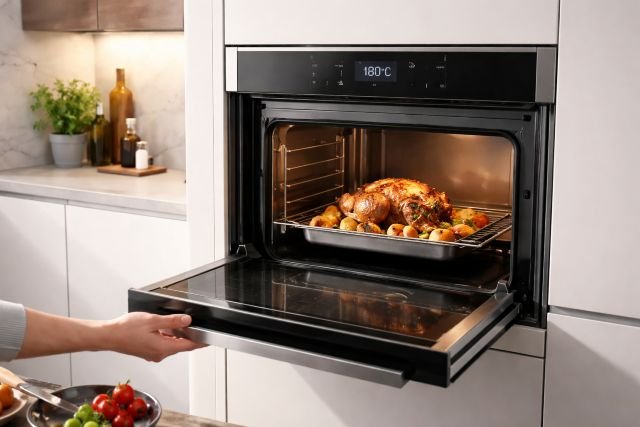
If your kitchen ever feels like a traffic jam the moment the oven door drops open, you’re not imagining it. A traditional drop-down door turns “in front of the oven” into a temporary obstacle course, especially in galley kitchens, narrow walkways, and open-plan spaces where people naturally pass through the cooking zone. That’s exactly why the slide and hide oven has become such a talked-about upgrade: it solves the door problem in the most literal way by letting the door disappear.
A slide and hide oven is a built-in oven whose door opens and then retracts fully beneath the oven cavity, so you can stand closer and work more comfortably. NEFF’s Slide&Hide® is the most well-known implementation, and the brand explains that the oven door “disappears entirely,” giving you extra room for basting, checking food, and cleaning.
This article covers how the design works, what benefits actually show up day to day, what to look for before you buy, and how to decide if it’s worth the premium for your kitchen and cooking habits.
What is a slide and hide oven?
A slide and hide oven is a built-in oven with a door engineered to move out of your way after opening. Instead of staying folded down and projecting into the room, the door slides into a compartment under the oven cavity. NEFF describes this as a door that disappears with a single move, creating extra room and easier access when you’re cooking or cleaning.
In simple terms, it’s an oven designed to remove the “door ledge” you normally have to lean over. That one change can make a kitchen feel noticeably less cramped, even if you don’t renovate anything else.
Why the retracting door changes how a kitchen feels
Most appliance features are about cooking results. This one is about the space around the cooking. When an oven door swings down and stays open, it claims a chunk of floor space right where your feet and knees want to be. You step back, twist sideways, or wait for someone to pass behind you before you pull out a tray.
With a retracting door, the working zone in front of the oven stays clearer. You can move in closer, keep your stance stable, and focus on handling hot cookware instead of navigating around the door. NEFF positions Slide&Hide® as a way to get closer for tasks like basting a roast or “getting in for a good cleaning,” precisely because the door isn’t blocking you.
This is also why the feature tends to feel most transformative in real homes with real constraints. If your oven sits opposite a sink run, beside an island, or in a corridor-like kitchen, a door that disappears can reduce everyday friction more than people expect.
Slide and hide oven benefits that matter in daily cooking
More space where it counts most
The big promise is space-saving, but it’s not about making your kitchen bigger on paper. It’s about reclaiming the moment-to-moment clearance you lose every time you open the oven. In a tight layout, that can mean you’re no longer pinned against a counter edge while lifting out a heavy roasting tray.
NEFF highlights “extra room” as a core advantage of the disappearing door, and that’s the benefit owners tend to notice instantly.
Easier access for checking, tasting, and lifting heavy items
Better access isn’t just convenience; it can change how confidently you handle hot dishes. NEFF’s materials emphasize easier access for monitoring food, and also call out that improved access can make lifting heavy or large items easier, reducing the risk of drops or spills.
If you cook with cast iron, deep roasting trays, or large casserole dishes, the ability to stand closer can feel like an ergonomic upgrade, not a gimmick.
Potential safety upside in busy households
No oven is “safe” by default, but removing a big, open door from the walkway can reduce one common hazard: a hot surface that sticks out into the room when you’re juggling food and attention. Child burn injuries are a real public health concern; one infographic drawing on CPSC-operated NEISS data reports roughly 296,299 unintentional, non-fatal burns treated in emergency departments among U.S. infants, children, and adolescents (<1–19) over 2020–2023, averaging over 74,000 per year.
A retracting door won’t prevent every kind of burn, but it can remove an obstacle that contributes to accidents in the “busy moment” when a tray comes out and someone walks through the kitchen at the wrong time.
Slide and hide oven vs standard built-in ovens
The easiest way to think about it is this: standard ovens ask you to work around the door. Slide-and-hide models try to remove the door from the equation.
With a classic drop-down door, your workflow often includes stepping back to open the door, leaning over it to reach the racks, and keeping that door in mind while you pull food out. With a retracting door, you can usually stand closer, reach in with less bending, and have a clearer path for lifting items straight out.
NEFF also offers versions with Soft Open & Close, describing a damping system that helps the door open and close gently and quietly. If you cook often, that “small” detail can make the appliance feel more premium day to day.
Who should consider a slide and hide oven?
A slide and hide oven tends to be a strong fit when space and traffic flow are your pain points. If your oven is placed where people walk through, or if the area in front of it is tight because of an island or nearby cabinets, the retracting door solves a very specific problem.
It’s also worth considering if you regularly cook heavy meals and want easier access. The more often you handle large trays, the more value you’ll get from being able to stand closer and lift with a stable stance, which aligns with NEFF’s “easier lifting” positioning.
On the other hand, if you have generous clearance in front of the oven and you rarely cook anything large, the feature may not change your daily life enough to justify the premium. In that case, you might get more value from other upgrades like a temperature probe, better telescopic rails, steam-assist cooking, or higher-end ventilation.
Buying guide: what to check before you choose one
Installation and cabinetry requirements
Because the door retracts beneath the cavity, the oven’s design and required clearances can differ from standard models. The practical takeaway is simple: don’t assume any built-in oven slot is automatically suitable. Your installer or kitchen designer should confirm the exact installation specs for the model you choose.
This matters even more if you’re replacing an older built-in unit and trying to keep the same cabinet. The best buying experience is the one where you verify fit early, rather than discovering constraints late.
Cleaning and long-term maintenance
NEFF explicitly frames the disappearing door as helpful for “getting in for a good cleaning,” which makes sense because you aren’t reaching around an open door to wipe corners. Still, cleaning convenience depends on the full package, not just the door.
Look at whether the oven supports cleaning systems like pyrolytic cleaning, how easy it is to remove accessories, and what the warranty and service network look like in your area. A specialized mechanism is only a downside if service is hard to access, so it’s worth checking brand support where you live.
Energy efficiency and running cost reality
Energy efficiency isn’t determined by the door style alone. It’s mostly about insulation, heating system design, fan performance, and how you use the oven. That said, comparing energy consumption is easier today because energy labels and ecodesign requirements provide standardized information in many markets.
The European Commission’s product guidance notes that energy labelling and ecodesign requirements apply to domestic ovens, and references ecodesign regulation coverage for cooking appliances, with energy labelling mandatory for ovens and range hoods.
If you want a practical way to estimate cost, the Sustainable Energy Authority of Ireland explains that energy labels include consumption information in kilowatt-hours under specified conditions, and that you can estimate costs by multiplying the kWh figure by your electricity unit price. For broader, general guidance on estimating appliance electricity use and cost, the U.S. Department of Energy also provides consumer-friendly advice on how to estimate electricity usage and compare efficiency.
Features that matter as much as the retracting door
Many buyers focus so much on the door that they forget to evaluate how the oven actually cooks. Prioritize consistency of heat, usability, and the tools that match your cooking habits. If you bake often, pay attention to fan cooking and multi-shelf performance. If you roast often, consider probe options. If you want low-effort upkeep, prioritize cleaning systems you’ll actually use.
The “right” slide-and-hide oven is the one that nails both the space benefit and the cooking experience.
A realistic scenario: how it can transform a tight kitchen
Imagine a weeknight dinner where you’re pulling a bubbling tray of lasagna from the oven while someone else tries to pass behind you to set the table. With a standard oven door, you might need to step back to clear the door, then shift sideways to let someone through, all while holding a hot, heavy dish.
With a retracting door, your stance can stay closer to the oven, and the path behind you is less likely to be blocked by a wide, open door. That kind of smoothness doesn’t show up on a spec sheet, but it shows up in how your kitchen feels when real life is happening in it.
FAQ: quick answers people search for
What is a slide and hide oven?
A slide and hide oven is a built-in oven with a door that opens and then retracts underneath the oven cavity, so the door no longer protrudes into the kitchen while you load, check, or remove food. NEFF describes this as a door that “disappears entirely,” giving you extra room to work.
Are slide and hide ovens worth it?
They’re most worth it when your kitchen is tight, your oven sits in a walkway, or you frequently handle heavy trays. The value comes from improved access and reclaimed space during the moments you use the oven most. If your kitchen already has plenty of clearance, the upgrade can still feel premium, but it may not be as life-changing.
Do slide and hide ovens make cooking safer?
They can make the space around the oven easier to manage by removing a protruding door from the walkway, which may reduce awkward handling moments. Burn injuries among children are common enough to be a major safety topic, with NEISS/CPSC-based data showing tens of thousands of non-fatal burns treated annually in the U.S. pediatric population. A retracting door is not a complete safety solution, but it can remove one frequent hazard point.
Do they cost more to run?
Not inherently. Running cost depends on the oven’s energy consumption and your electricity price. Energy label resources explain that consumption is shown in kWh under specified conditions, and you can estimate cost by multiplying kWh by your per-unit rate.
What should I check before buying?
Confirm cabinet fit and installation requirements, check warranty and service availability, compare energy consumption information, and evaluate cooking features you’ll use often. The retracting door is the headline feature, but the best long-term satisfaction comes from choosing an oven that also excels at the type of cooking you do.
Conclusion
A slide and hide oven isn’t just a flashy mechanism; it’s a practical redesign of the space where cooking actually happens. By letting the door retract beneath the cavity, it can free up room in tight layouts, improve access for checking and lifting dishes, and reduce the everyday hassle of navigating around an open door. NEFF’s own description focuses on the door disappearing to create extra room for cooking tasks and cleaning, which aligns with why many homeowners notice an immediate difference.
If you’re planning a renovation or upgrading a built-in oven in a compact or high-traffic kitchen, this is one of the few features that can make the entire room feel more usable without changing your floor plan. And if you pair the retracting door with the right cooking and cleaning features for your lifestyle, it’s the kind of upgrade you’ll appreciate every time dinner goes in and comes out.