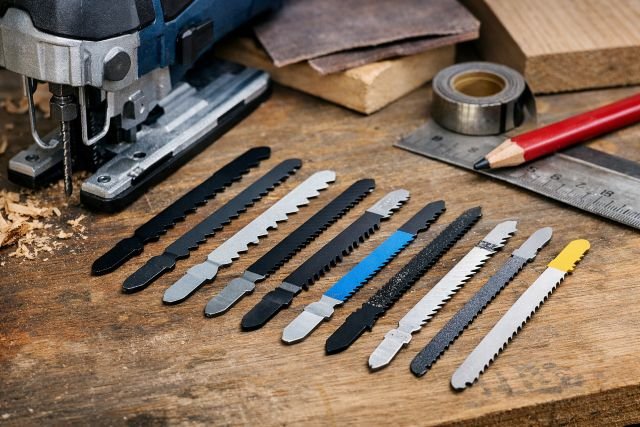
If your jigsaw cutter blade is wandering off the line, scorching plywood, or chattering through metal, it’s rarely “your jigsaw.” Most of the time, it’s the blade choice (and how it matches the material thickness). Pros don’t carry one magic blade — they keep a small, repeatable rotation: a fast wood blade for rough sizing, a clean-cut blade for finish work, and a few specialty blades for laminate, metal, and tile. The good news is you can copy that playbook without buying a hundred-piece set you’ll never use.
Below are the blade types and specific pro-leaning picks that show up again and again on job sites — plus how to choose the right teeth-per-inch (TPI), width, and material so your cuts look intentional.
What Makes a “Pro” Jigsaw Cutter Blade Different?
A professional-grade blade isn’t just “sharper.” It’s engineered to stay straight, clear chips efficiently, and survive heat — especially in metal. Here’s what pros pay for:
A more secure shank (usually T-shank). T-shank blades are the modern default because they clamp firmly and swap quickly. Many brands emphasize that T-shank fits most current jigsaws and improves grip/stability.
Tooth design matched to the job. High TPI generally means smoother cuts but slower feed; lower TPI cuts faster with a rougher edge — exactly the tradeoff most guides teach.
Blade steel that matches the abuse.
- HCS (high-carbon steel): great for wood; dulls fast in metal.
- HSS (high-speed steel): better for metal and heat.
- Bi-metal (BIM): flexible backbone + hard tooth edge — excellent “workhorse” choice.
- Carbide teeth / diamond grit: for very abrasive stuff (thick metal, fiberglass, tile) where ordinary teeth die quickly. Diablo, for example, positions carbide jigsaw blades as extreme-life options for thick metals.
Quick Definition for Featured Snippets: What Is a Jigsaw Cutter Blade?
A jigsaw cutter blade is a replaceable, narrow saw blade designed for a jigsaw to cut curves and shapes in materials like wood, plywood, laminate, plastic, metal, and tile. Choosing the right blade depends on shank type (often T-shank), tooth count (TPI), tooth geometry, and blade material (HCS/HSS/bi-metal/carbide/diamond grit).
The Pro Rotation: Jigsaw Cutter Blade Picks That Actually Get Used
Instead of “best blades overall,” this is organized like a real toolbox — by the cuts you actually make.
1) Everyday Wood Blade (fast, controlled, not precious)
What pros use it for: rough sizing studs, sheathing, framing lumber, quick cutouts where finish quality isn’t the priority.
Look for: lower-ish TPI, aggressive tooth set, thicker body to resist deflection.
Good pro-leaning picks:
- Bosch T 144 D “Speed for Wood” style blades for fast straight cuts in softwood. Bosch positions this pattern specifically for speed and straight cuts.
- General-purpose Bosch wood T-shank options (e.g., popular 10 TPI patterns) when you want a balance of speed and edge quality; Bosch highlights this as one of the most popular “all-around use” wood blades.
Real-world scenario: You’re cutting a sink opening in a countertop substrate or trimming back cabinet toe-kicks. A fast wood blade keeps the job moving. Then you switch blades for the visible edge.
2) Clean-Cut Wood Blade (finish edges, less tear-out)
What pros use it for: visible plywood edges, cabinet panels, trim notches, clean template work.
Look for: higher TPI and tooth geometry meant for “clean” cutting.
Good pro-leaning picks:
- Bosch “Expert for Wood” clean-cut lines (their marketing focuses on extra-clean cuts and long life in wood, with tooth geometry tuned for smoothness).
- Festool wood “universal” blades if you’re already in the Festool ecosystem and using a guide rail setup; Festool explicitly frames certain blades as ideal with their guide rail for right-angled cuts.
Pro tip that matters: If the face veneer is prone to splintering, cut with the “good face” down or use a blade designed for clean cuts — then slow the orbital action. Even many general jigsaw-use guides emphasize matching TPI and blade type to reduce tear-out.
3) Laminate / Melamine Blade (the “don’t chip my finish” specialist)
What pros use it for: laminate countertops, melamine cabinet parts, prefinished panels.
Look for: very fine teeth (higher TPI), and designs aimed at minimizing chipping.
Solid pro-leaning families:
- Diablo jigsaw blade lineup for laminate/melamine (they explicitly position blades for laminate/melamine and other brittle finishes).
- Bosch specialty wood blades (Bosch catalogs multiple tooth designs and materials for specialized materials, with simplified selection systems).
Mini case study: Installers often do a rough opening fast, then “finish pass” the visible edge. That second pass is where laminate blades earn their keep — because a chipped edge means filler, color-matching, and time.
4) Thin Metal Blade (electrical, ducting, light angle)
What pros use it for: EMT strap adjustments, thin sheet, light-gauge steel, aluminum sheet.
Look for: higher TPI, metal-rated steel (HSS or bi-metal), steady feed to avoid heat.
Good pro-leaning picks:
- LENOX jigsaw blades (bi-metal range) — LENOX emphasizes durability and productivity for professional users, with tech aimed at reducing breaks.
- Makita HSS T-shank jigsaw blade options — Makita explicitly highlights HSS for faster cutting and longer life than HCS.
Practical note: If your blade is turning blue, you’re overheating it. Ease pressure, reduce orbital action, and let the teeth do the work.
5) Thick Metal Blade (brackets, heavier stock, “this is a lot for a jigsaw”)
What pros use it for: thicker steel sections when a band saw/grinder isn’t convenient, occasional heavy cutting.
Look for: bi-metal designed for thick metal or carbide teeth for extreme durability.
Pro-grade picks:
- Diablo bi-metal thick metal blades — some product listings specify thick-metal ranges and claim significantly longer life vs standard blades (useful when you’re doing repeated cuts).
- Diablo carbide thick-metal blades — Diablo positions carbide teeth as “extreme durability” and claims up to “50X longer” life versus standard jigsaw blades in thick metals.
When pros don’t use a jigsaw: If you’re doing a lot of thick steel, the “pro move” is switching tools, not burning through blades. But for a handful of cuts, carbide pays for itself fast.
6) Tile / Fiberglass / Abrasive Materials (diamond grit territory)
What pros use it for: tile cutouts, cement board tweaks, fiberglass panels, other abrasive materials that kill normal teeth.
Look for: diamond grit or carbide grit (not ordinary teeth).
Pro-leaning family:
- Diablo’s lineup includes diamond grit and carbide options for abrasive materials like tile.
Reality check: Jigsaws can do tile cutouts, but dust control and edge finish matter. If it’s a visible cut line, pros often score-and-snap or use a wet saw — then reserve the jigsaw for inside corners and odd shapes.
How Pros Choose the Right Blade in 20 Seconds
Here’s the “jobsite checklist” that keeps you from guessing:
- Match the shank first. If your jigsaw takes T-shank, stick with it; many brands emphasize T-shank compatibility across most modern saws.
- Match TPI to thickness. Higher TPI = smoother but slower; lower TPI = faster but rougher.
- Match blade steel to heat/abuse. Wood = HCS; metal = HSS/bi-metal; abrasive/thick metal = carbide/diamond.
- Choose blade width for the cut. Narrower blades turn tighter; wider blades track straighter (a common technique taught in general jigsaw guides).
Common Questions Pros Hear (FAQ for Featured Snippets)
What is the best all-purpose jigsaw cutter blade?
A bi-metal T-shank blade set is usually the most “all-purpose” for mixed materials because it balances flexibility and tooth durability. For pure wood, many pros keep a popular mid-TPI wood blade as the default and switch to specialty blades for laminate or metal.
T-shank vs U-shank: what should I buy?
If your jigsaw accepts T-shank, buy T-shank — it’s widely treated as the modern standard for quick changes and secure clamping. U-shank is less common on newer saws.
Why does my jigsaw blade bend or wander?
Usually it’s one (or more) of these: the blade is too thin for the material, TPI is wrong for thickness, you’re pushing too hard, or the blade is dull/overheated. Switching to a thicker-bodied blade (or a blade designed for straight cuts) and reducing feed pressure fixes most “wandering.”
Can I cut metal with a wood blade?
You can, but you shouldn’t. HCS wood blades dull quickly and overheat in metal; manufacturers typically recommend HSS/bi-metal for metal cutting.
Actionable Pro Tips That Save Blades (and Time)
- Let the blade set the pace. If the motor bogs or the blade squeals, you’re forcing it. Back off and keep the shoe flat.
- Dial down orbital action for clean cuts and metal. Orbital is great for fast wood removal, but it increases tear-out and heat.
- Use the right “specialty” blade earlier than you think. For laminate, melamine, and thick metal, the specialty blade is cheaper than rework. Diablo explicitly positions carbide/diamond options for the materials that punish standard teeth.
- Buy fewer blades, but the right ones. A tight kit (fast wood, clean wood, laminate, thin metal, thick metal/carbide, diamond grit) beats a bargain multi-pack where half the blades are redundant.
Conclusion: Build a Small, Pro-Level Jigsaw Cutter Blade Kit
A pro doesn’t overthink every cut — they standardize the decision. Keep a fast wood blade for rough work, a clean-cut blade for finish edges, a dedicated laminate/melamine blade for chip-prone surfaces, and metal blades that match thickness (bi-metal for most tasks, carbide when the job is punishing). That simple rotation is how you get straighter cuts, cleaner edges, and fewer snapped blades — without blaming your jigsaw.