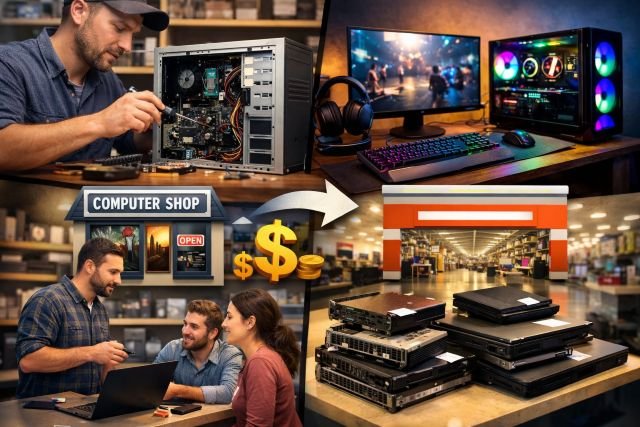
Walk into a big retail store and the experience often feels the same: bright lights, long aisles, and a system designed for volume. Walk into a comp shop and it’s usually different from the first hello — more human, more flexible, and more focused on solving your specific problem, not moving you to the next checkout.
That difference matters more than ever. Customers increasingly choose businesses that deliver a better experience and convenience, even if it costs a little more. PwC’s research shows 43% of consumers would pay more for greater convenience and 42% would pay more for a friendly, welcoming experience. And when service is bad, customers don’t just complain — they leave: research summarized by Qualtrics/ServiceNow found 80% of customers have switched brands due to poor customer experience.
So why does a comp shop consistently outperform big retail in real life — especially for computers, electronics, accessories, repairs, upgrades, and ongoing support? Let’s break it down.
What is a comp shop?
A comp shop (short for “computer shop”) is a specialized local retailer or service provider focused on computers and related technology — sales, repairs, upgrades, diagnostics, custom builds, data transfers, networking, and troubleshooting.
Big retail stores may offer some of those services, but they’re usually packaged, standardized, and routed through rigid policies. A comp shop tends to operate with expertise-first decision-making: diagnose, explain options, and tailor the fix.
1) A comp shop gives you solutions — not just products
Big retail is optimized to sell inventory at scale. That can be great when you already know exactly what you want. But if you’re not 100% sure — your laptop is slow, your PC overheats, Wi-Fi keeps dropping, storage is full — buying a new device isn’t always the smartest move.
A comp shop typically starts with diagnosis, not a sales pitch.
That matters because many “replace it” situations are actually “repair it or upgrade it” situations. The U.S. FTC has noted that many products have become harder to fix and maintain, often requiring specialized tools, parts, and access to proprietary diagnostic software — reducing consumer choices. A good comp shop is built to navigate those real constraints and still give you options.
Real-world scenario:
Your laptop takes 8 minutes to boot. Big retail suggests a new one. A comp shop runs a quick health check, finds a failing hard drive, upgrades to an SSD, cleans startup bloat, and you’re back in business — often for a fraction of replacement cost.
2) Better value over time (not just “lowest sticker price”)
Big-box pricing can look unbeatable — until you add the hidden costs:
- wasted time re-explaining your issue to multiple departments
- accessory bundling you didn’t need
- service plans that don’t cover your exact problem
- slower turnaround that forces you into downtime costs
A comp shop wins on total cost of ownership—the cost you pay over months and years.
Even major retailers admit friction is expensive. Returns are a massive cost center: the National Retail Federation and Happy Returns projected $890 billion in retail returns in 2024, with an estimated 16.9% return rate. That return volume is a symptom of mismatch: customers buying something that seemed right but wasn’t. Comp shops reduce that mismatch by guiding you to the right fit the first time.
3) Faster turnaround and more realistic timelines
Big retail service desks often run on queues, shipping devices out, and standardized workflows. If your computer is your work tool, that model can be painful.
Comp shops are usually set up for same-day or next-day diagnostics, quicker part sourcing, and direct technician access. Even when a repair takes time, you’ll typically get a clearer explanation of what’s happening and why.
There’s also a broader trend pushing people toward local solutions: online discovery is increasingly local-first. Google itself has highlighted growth in “shopping near me” behavior (reported as over 100% year-over-year in one statistic cited by Backlinko). People are looking for nearby help because waiting a week isn’t a strategy — it’s lost productivity.
4) More trust and less “corporate scripting”
Big retailers train for consistency. Comp shops build trust through competence and transparency.
When something goes wrong in big retail, the resolution path is usually: policy → manager → ticket → escalation. In a comp shop, it’s more often: technician → explanation → options → fix.
And trust isn’t fluffy — it’s economic. Harvard Business Review notes that acquiring a new customer can cost 5 to 25 times more than retaining an existing one. Comp shops survive on retention, referrals, and reputation, so they’re structurally motivated to treat you well every time.
5) A comp shop is better for repairs, upgrades, and “keep it running” support
If you’ve ever been told “we don’t do that here,” you already know the big retail limitation: they’re not built for edge cases.
Comp shops thrive on edge cases:
- random blue screens
- intermittent charging
- thermal throttling
- dead SSDs
- RAM instability
- malware cleanup
- BIOS updates
- data recovery triage
- custom PC builds for gaming/editing/engineering
This is where the Right-to-Repair conversation becomes practical. The FTC’s “Nixing the Fix” report explains how repair restrictions can increase costs and limit consumer choice, and it points out how modern repairs can require specialized tools and proprietary diagnostics. A comp shop’s daily work is navigating those constraints and still finding a workable, cost-effective path.
6) More customization (your workflow actually matters)
Big retail sells categories: “student laptop,” “gaming laptop,” “office printer.” A comp shop sells outcomes: “smooth Zoom calls,” “4K video editing without stutter,” “quiet PC that renders fast,” “Wi-Fi that doesn’t drop.”
That shift is huge because “best” depends on your use:
- A developer might need RAM and CPU threads.
- A designer might need color accuracy and GPU memory.
- A student might need battery life and durability.
- A business might need managed backups and endpoint security.
Personalization is a competitive moat. Research and industry analysis repeatedly show consumers expect experiences tailored to them. Comp shops can deliver this because they’re not forced into one-size-fits-all SKUs and scripts.
7) Access to expertise (and honest tradeoffs)
In a comp shop, the person advising you is often the person fixing the problem—or sits next to the person who will. That creates accountability and clarity.
Instead of “this is the plan,” you’re more likely to hear:
- “Here are the top two fixes and what they cost.”
- “Here’s what’s worth upgrading vs replacing.”
- “Here’s the risk if we try the cheaper option first.”
That transparency reduces buyer’s remorse and costly returns (which, again, are massive at the industry level).
8) Comp shops keep money in the community (and that improves service)
Local businesses aren’t just “nice to support”—they have measurable economic impact. In the U.S., small businesses have played a major role in job creation: between Q1 2021 and Q2 2024, small businesses made up 52.8% of total net job creation (BLS Business Employment Dynamics).
When a comp shop earns your loyalty, it reinvests in local staff, faster parts sourcing, better tools, and better technicians. Big retail reinvestment is usually centralized and spread across unrelated categories.
9) Better after-sales support (the part most people ignore)
A laptop purchase isn’t the finish line. It’s the beginning of:
- updates
- backups
- password resets
- storage management
- peripheral compatibility
- security and performance maintenance
Comp shops often offer ongoing support packages, maintenance plans, and “bring it in and we’ll check it” relationships — especially valuable for small businesses and families with multiple devices.
And because customer experience drives loyalty, this isn’t just feel-good service. PwC found 65% of U.S. customers say a positive experience is more influential than great advertising. Comp shops win because they can deliver that positive experience consistently.
10) Fewer “surprise limitations” and more realistic advice
Big retail is full of invisible boundaries:
- “We can’t open the device.”
- “We don’t handle data recovery.”
- “We can’t install that part.”
- “That software isn’t supported.”
A comp shop is much more likely to say:
- “Yes, but here’s the risk.”
- “Yes, and here’s the proper way.”
- “No, but here’s a better alternative.”
That honest guidance prevents expensive mistakes.
How to choose the right comp shop
Here are quick, practical filters that separate great comp shops from average ones:
- They explain before they charge big money. A good shop starts with diagnosis and options.
- They give tradeoffs. “Cheap, fast, perfect — pick two” is real in tech; the best shops are honest about it.
- They document work. Even simple notes build trust and make future support easier.
- They respect your data. Clear privacy practices and consent-based handling are non-negotiable.
- They help you prevent the next problem. The best fix includes a tip: backups, cooling habits, antivirus hygiene, or storage planning.
Featured snippet-friendly FAQ
Is a comp shop cheaper than a big retail store?
Often, yes—especially for repairs and upgrades. Big retail may have lower sticker prices on some products, but comp shops frequently deliver better total value by avoiding unnecessary replacements and reducing downtime.
Are comp shop repairs safer or more reliable?
They can be, because comp shops specialize in diagnostics and hands-on fixes. The FTC has highlighted how modern repairs can require specialized tools, parts, and proprietary diagnostics — specialization matters.
Why do people still buy from big retailers then?
Convenience, brand familiarity, and aggressive promotions. But as customer expectations rise, more people choose local businesses for better service and faster solutions — especially when they search “near me” for immediate help.
What should I ask a comp shop before paying?
Ask for: (1) the likely cause, (2) the top 2–3 repair options, (3) total cost range, (4) turnaround estimate, and (5) whether your data will be accessed and how it’s protected.
Conclusion: why a comp shop wins — again and again
At the end of the day, the reason a comp shop beats big retail stores “every time” is simple: big retail is built to move products, while comp shops are built to solve problems.
You get better diagnostics, smarter upgrade paths, faster fixes, more transparent advice, and support that feels like a relationship — not a ticket number. In a world where customers value convenience and welcoming service (and will literally pay more for it), the comp shop model isn’t old-fashioned — it’s the future of tech buying and tech support.