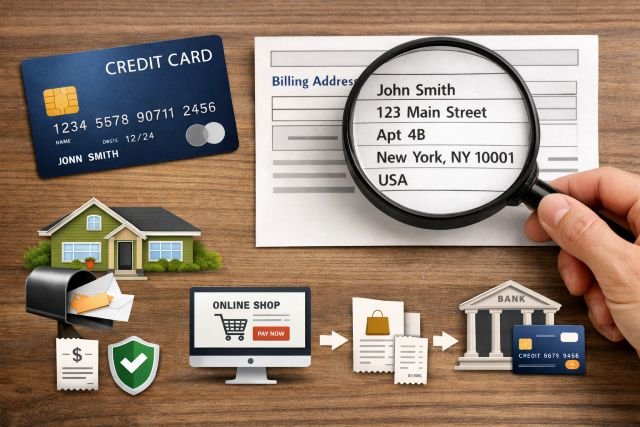
If you’ve ever checked out online and been asked to enter a billing address, you might’ve paused and thought, “whats a billing address — and why does the website need it?” You’re not alone. This is one of the most common points of confusion in online payments, and it can also be a major reason transactions fail with messages like “address mismatch” or “payment declined.”
In simple terms, a billing address is the address your bank or card issuer has on file for your debit or credit card account. When you type that address during checkout, many websites use it as part of a security check to confirm you’re the real cardholder. This matters most during online purchases, where the merchant can’t physically see the card.
What is a billing address on a debit or credit card?
A billing address is the address connected to your card account in your issuer’s records. It’s usually the address used for account registration and often the same place where your bank sends statements, though that can vary depending on your bank’s settings.
The reason this address exists in payment flows is verification. Many merchants run an Address Verification System check, commonly called AVS. AVS compares the billing address you enter at checkout against the address your issuer has on file, then returns a result that helps the merchant decide whether to approve or decline the transaction. Visa describes AVS as a method of verifying address details provided in a transaction against issuer records.
Even though it sounds minor, this address check can carry weight, especially for card-not-present purchases, which generally involve higher fraud risk than in-person payments.
Why websites ask for your billing address
Online shopping is different from using a card in a store. When you pay in person, your chip, tap, or PIN can help verify the transaction in ways that don’t rely on your address. Online, the merchant has fewer signals to confirm you’re the rightful cardholder, so billing address verification becomes one of the quickest and most common fraud controls.
This matters because card fraud is costly globally. The Nilson Report’s figures reported via a GlobeNewswire release estimate worldwide payment card fraud losses of $33.41 billion in 2024, tied to $51.920 trillion in payment card volume. That scale of loss is why merchants often use layered checks like CVV plus AVS, especially for higher-risk transactions.
Billing address vs shipping address: what’s the difference?
The billing address is the address tied to your payment method. The shipping address is where you want the product delivered. They can be the same, and for many purchases they are, but they don’t have to be.
A common real-life example is sending a gift. You might ship the item to a friend, but the billing address should still match the address your bank has on file. Another example is travel. You might ship to a hotel or temporary location, but the billing address remains tied to your card account unless you formally change it with your issuer.
When a checkout asks for both billing and shipping addresses, it’s important not to automatically copy the shipping address into the billing field unless they truly match. Address mismatch is a frequent reason for declines.
How billing address verification works in real life
During checkout, you enter your card details and your billing address. The merchant passes the transaction through a payment processor to your issuer. If the merchant uses AVS, the issuer compares the address details you provided to what’s stored on your card account, then returns an AVS response code indicating a match, partial match, no match, or that the check is unavailable for that transaction.
One important detail is that AVS often focuses on specific parts of the address, such as the numeric portion of the street address and the ZIP or postal code, rather than every character exactly as typed. That’s why a transaction can sometimes succeed even if abbreviations differ, and fail if the ZIP or street number is wrong.
AVS support can also vary by country, issuer, or transaction type. In some cases the system returns a result indicating that AVS wasn’t supported or couldn’t be performed.
Common reasons billing address errors happen
Billing address problems usually have straightforward causes, even when the error message feels vague.
One of the most common causes is moving to a new home and forgetting to update the address with the bank. Your card may still be tied to your previous address, and the issuer will treat your new address as a mismatch until the record is updated.
Another common cause is entering the right address in the wrong way. Some checkout forms split address fields differently. Others dislike extra punctuation, missing unit numbers, or unusual formatting. While postal formatting rules are primarily about mail delivery, official addressing guidance like USPS standards shows why many systems prefer consistent structures such as city, state, and ZIP in predictable places.
A third cause is mixing up billing and shipping. This happens a lot when the item is being shipped to a different location.
Finally, sometimes the bank’s record is slightly different than what you think. Your issuer might store your address without an apartment number, with a shortened street name, or under an older spelling. If you keep seeing a mismatch, it’s worth checking the exact address stored on your account.
How to find the billing address for your card
If you’re not sure what the billing address is, the safest method is to check the address your bank has stored for your account. You can often find it in your mobile banking app under profile or account settings, or in online banking under personal details. If you still can’t confirm it, calling the issuer using the phone number on the back of the card is usually the fastest way to verify what address is on file for authorization checks.
This is especially helpful when you suspect your billing address might still be an older address or when you recently updated your information and want to confirm that the change is active.
How to update your billing address
Updating your billing address typically happens through your bank’s app, web portal, customer service phone line, or a physical branch if available. The key is that the issuer must update the address tied to your card account, not just the shipping address on a separate merchant profile.
Some banks apply address changes immediately, while others may take some time to fully propagate through authorization systems. If you update your address and a transaction still fails shortly after, it may help to retry later or contact the bank to confirm the address is active for card authorization and AVS.
Billing address examples for debit and credit cards
A typical billing address looks like a standard postal address with a street line, optional unit, and a final line including city and postal code. For example, an address might be entered as “1207 Maple Ave Apt 4B, Springfield, IL 62704” in the United States.
If you use a business card, the billing address might be the business office location used when the card account was set up. In some cases a PO Box may be associated with the account, but acceptance depends on your bank and the merchant, because some merchants require a physical street address for verification.
Tips to avoid billing address declines
The simplest rule is to match the address your issuer has on file, even if it isn’t your current location. If you recently moved and haven’t updated your bank, the old address is still the one that will verify. Another reliable practice is double-checking your ZIP or postal code, because that element is commonly used in AVS matching.
It also helps to ensure apartment or unit numbers are entered consistently with what your bank stores. If your issuer includes the unit in its record and you omit it, some merchants may treat that as a mismatch depending on how strict their rules are.
Finally, if the merchant offers an alternative checkout method like a digital wallet, it can sometimes bypass address-entry mistakes while you correct the issuer record, though your underlying account address still matters in many scenarios.
Is the billing address printed on your card?
Usually it is not. Most debit and credit cards do not print a billing address on the physical card. The billing address is stored in the issuer’s systems and used during certain types of verification, particularly for online transactions.
If a checkout page says “billing address as it appears on your card,” it typically means “the billing address attached to your card account,” not something printed on the plastic.
Does billing address matter for in-store purchases?
Most of the time, billing address checks matter more for online purchases. In a physical store, the transaction is authenticated using methods like chip or contactless verification. Online transactions are card-not-present, and merchants often rely on additional signals like billing address verification to reduce fraud risk.
That said, certain situations like phone orders, higher-risk orders, or merchant-specific fraud controls can still make billing address relevant even if you’re not physically present.
Is it safe to enter your billing address online?
In general, yes, because it is a standard part of fraud prevention and payment verification. AVS and similar checks exist to reduce unauthorized transactions by comparing the details you provide with what the issuer has stored.
Still, you should only enter your billing address and card details on websites you trust. Consumer protection agencies like the FTC track fraud trends and provide guidance because scams and identity theft remain common.
FAQs
Whats a billing address in one sentence?
A billing address is the address your bank has on file for your debit or credit card account, used to verify certain purchases, especially online.
Is billing address the same as home address?
Often, but not always. It’s whatever address your issuer has stored for your card account, which could be a previous address or a business address.
What happens if I enter the wrong billing address?
Your payment may be declined, flagged for review, or processed with a higher fraud risk score, depending on the merchant’s settings and the issuer’s AVS response.
Why does my billing address fail even when I think it’s correct?
It may be because your issuer has a different address on file, you entered the wrong ZIP or postal code, your unit number doesn’t match, or the checkout form formatting differs from the stored record.
Conclusion
Now you know exactly whats a billing address and why it shows up during checkout. It’s the address your bank has on file for your card account, and it’s often used for security checks like AVS to reduce fraud and confirm you’re the real cardholder. If your payment fails, the fix is usually verifying the exact address stored by your issuer, paying special attention to the ZIP or postal code, then updating your address with your bank if it’s outdated. Getting this one detail right can prevent declines, protect your account, and make online payments much smoother.